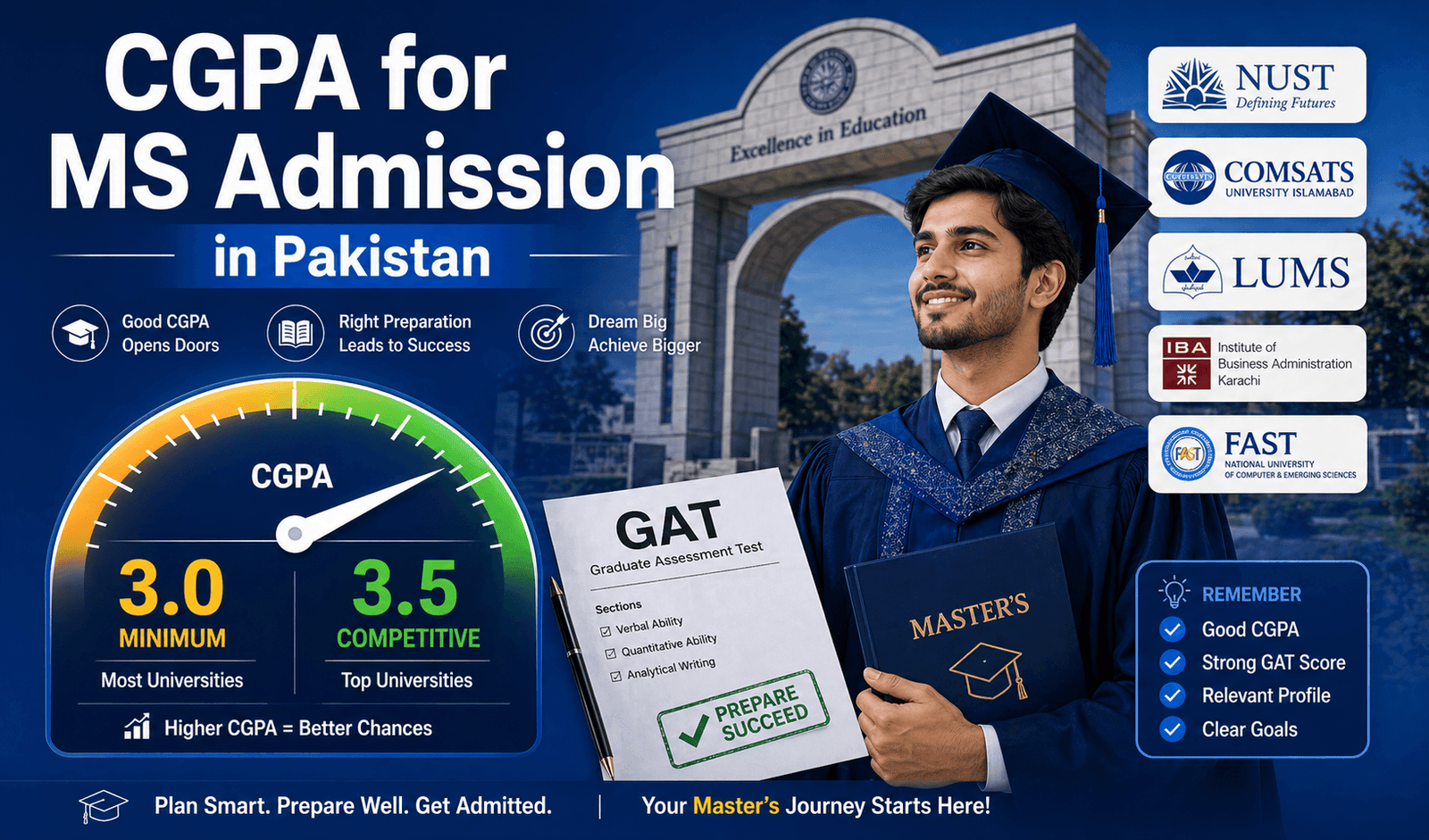
Every year, thousands of Pakistani graduates apply for MS (Master of Science) and MPhil programs at universities across Pakistan. The competition is fierce — top programs at NUST, LUMS, IBA, COMSATS, and FAST receive far more applications than available seats. Your CGPA from your bachelor's degree is the single most important academic metric in this competition. But what CGPA is "good enough" to get in? What's "competitive"? And what else matters beyond CGPA? This comprehensive guide answers all these questions for 2025.
Part 1: Understanding Pakistani MS Admissions
MS admissions at Pakistani universities typically involve a multi-component evaluation system. CGPA is only one piece of the puzzle — but it's the piece that determines whether your application even gets reviewed. Most universities use a minimum CGPA cutoff as the first screening filter. Applications below this cutoff are automatically rejected without further review.
After clearing the CGPA filter, remaining components typically include:
- GAT General Score (NTS): Required by virtually all HEC-recognized universities for MS admission. Minimum qualifying score: typically 50 out of 100. Competitive score: 60+. Valid for 2 years.
- GAT Subject / Department Test: Some departments conduct their own specialized test assessing domain knowledge
- Interview: Shortlisted candidates appear before faculty panel. Key for research-oriented programs.
- Research Publications: Co-authored conference or journal papers carry significant weight, especially for PhD-track MS programs
- Work Experience: Relevant professional experience adds value, especially for MBA and management MS programs
- Statement of Purpose (SOP): Required by most programs; explains research interests and academic goals
Part 2: CGPA Requirements at Major Pakistani Universities
NUST MS Programs
| Program | Min CGPA | Competitive CGPA | Additional Requirements |
|---|---|---|---|
| MS Computer Science (SEECS) | 2.50 | 3.00+ | GAT General 50+; SEECS interview |
| MS Electrical Engineering | 2.50 | 3.00+ | GAT General 50+; strong math background |
| MS Software Engineering | 2.50 | 2.80+ | GAT General 50+ |
| MS Data Science (new program) | 2.50 | 3.20+ | Statistics and programming background |
| MBA at NBS | 2.50 | 2.80+ | GMAT/NBS test; work experience preferred |
| MS Natural Sciences (SNS) | 2.50 | 2.80+ | GAT Subject preferred |
COMSATS MS Programs
| Program | Min CGPA | Competitive CGPA |
|---|---|---|
| MS Computer Science | 2.00 | 2.50+ |
| MS Electrical Engineering | 2.00 | 2.50+ |
| MS Business Administration | 2.00 | 2.50+ |
| MS Mathematics / Physics | 2.00 | 2.50+ |
| MS Pharmacy / Biosciences | 2.00 | 2.50+ |
FAST-NUCES MS Programs
| Program | Min CGPA | Competitive CGPA |
|---|---|---|
| MS Computer Science | 2.50 | 2.80+ |
| MS Software Engineering | 2.50 | 2.80+ |
| MS Data Science | 2.50 | 3.00+ |
| MS Computer Engineering | 2.50 | 2.80+ |
Elite Programs — LUMS and IBA
| Program | Min CGPA | Competitive CGPA | Key Differentiators |
|---|---|---|---|
| LUMS MS Computer Science | 3.00 | 3.30+ | Strong coding skills; research background |
| LUMS MBA | 2.80 | 3.00+ | GMAT 600+; work experience; strong SOP |
| IBA Karachi MBA | 2.80 | 3.00+ | IBAEAT score; interview performance |
| IBA MS Economics | 2.80 | 3.20+ | Economics/mathematics background |
Part 3: The GAT General — Pakistan's MS Admission Test
The Graduate Assessment Test (GAT General), administered by NTS, is required for MS admission at virtually all HEC-recognized Pakistani universities. It tests:
- Quantitative Reasoning (30 questions): Arithmetic, algebra, geometry, data analysis — GRE Quantitative level
- Verbal Reasoning (30 questions): Vocabulary, reading comprehension, analogies, sentence completion
- Analytical Reasoning (20 questions): Logical inference, critical reasoning, deductive arguments
GAT scores: Minimum qualifying 50/100. Competitive: 60+. Valid 2 years. NTS conducts GAT sessions throughout the year — check ntspk.org for schedules. Budget 3 months of serious preparation (2 hours daily) to reach 60+. GRE preparation materials (Manhattan Prep, ETS Official Guide) are equally effective for GAT preparation.
Part 4: Building a Competitive MS Application While Still in BS
The best time to strengthen your MS application is while you're still completing your bachelor's degree. Actions that have the highest impact:
Year 2–3: Research Engagement
Approach a faculty member whose research interests you. Ask if you can assist with their ongoing project — even as an unpaid research assistant for one semester. This creates: a strong recommendation letter from a supervisor who knows your research ability; possible co-authorship if the project produces a paper; demonstrated research interest that strengthens your SOP; and familiarity with the research process before you're expected to do it independently in your MS thesis.
Year 3–4: CGPA Strategy
Use our CGPA Improvement Calculator in Year 3 to model what semester GPAs you need to reach your target cumulative CGPA by graduation. If you need 3.0 cumulative and currently sit at 2.7 after 90 credit hours with 40 CHs remaining, you need a future GPA of: (3.0 × 130 − 2.7 × 90) ÷ 40 = (390 − 243) ÷ 40 = 147 ÷ 40 = 3.68 minimum. That's achievable with strong final year performance — but requires knowing the number to plan toward it.
Year 4: FYP and Thesis Quality
Your Final Year Project (FYP) is your first research project and the most directly relevant experience for MS admissions committees. Choose a topic with genuine research novelty, work with a supervisor who has active research output, and produce a well-documented project report. If your FYP can generate even a workshop paper submission, this significantly differentiates your application from candidates with similar CGPA.
Year 4: Take GAT Early
Take the GAT General in your final year of BS, not after graduation. This gives you time to retake if needed, the score will be valid during your MS application window (2 years from test date), and preparing for GAT during your final year is more efficient than preparing after graduation when other pressures exist.
Part 5: HEC Overseas MS Scholarship — The CGPA Requirements
HEC's Overseas Scholarship Program for MS leading to PhD is the most prestigious funding opportunity for Pakistani graduates. Requirements for 2025:
- Minimum CGPA: 3.00 from your BS degree (4-year program from HEC-recognized university)
- Competitive CGPA: 3.50+ significantly increases your chances of selection
- GAT General: Minimum 60 (not just 50 — the scholarship standard is higher)
- Institutional ranking: Target universities in QS Top 500
- IELTS: Minimum 6.5 overall, no band below 6.0
- Letter of acceptance: Acceptance from a QS-ranked foreign university in a relevant field
- Field of study: Priority fields listed by HEC annually (typically STEM and emerging technologies)
The HEC Overseas Scholarship covers tuition, monthly stipend, health insurance, and return airfare. Competition is intense — hundreds of applications per available seat. A CGPA of 3.0 makes you eligible; a CGPA of 3.5+ with a strong GAT score and an acceptance from a QS top-200 university makes you genuinely competitive.
Part 6: Fulbright Pakistan — What Your CGPA Needs to Be
The Fulbright Pakistan scholarship, funded by the US State Department and administered by USEFP, is Pakistan's most prestigious US study scholarship. It covers tuition, stipend, health insurance, and travel for MS or PhD programs at US universities.
- Minimum CGPA: 3.00
- Competitive CGPA: 3.50+ (most selected scholars have 3.5+)
- Work experience: Minimum 2 years post-BS work experience (non-negotiable for most programs)
- IELTS/TOEFL: IELTS 6.5+ or TOEFL iBT 79+
- GRE: Not always required but strengthens application (Quant 155+)
- Application cycle: Opens January–February each year; deadline typically April
Part 7: Crafting a Competitive Statement of Purpose
For competitive MS programs, your Statement of Purpose (SOP) often determines selection among candidates with similar CGPA and test scores. Key SOP elements for Pakistani MS applicants:
- Opening hook: Start with a specific problem, observation, or experience that ignited your research interest — not "I have always been passionate about..."
- Academic background: Connect your BS coursework and FYP to your proposed MS research. Show how your academic preparation equips you for graduate study in this specific program.
- Research gap: Identify a specific gap in your field that your MS research will address. This demonstrates awareness of current literature and genuine research motivation.
- Program fit: Name specific faculty members, research groups, or courses at your target program. Generic SOPs that could apply to any university are immediately recognizable and unfavorably received.
- Career goals: Articulate what you will do after the MS — research career, industry application, PhD pursuit, national contribution. For national scholarships (HEC), specifically address your planned contribution to Pakistan.
- CGPA context (if needed): If your CGPA is below the ideal competitive range, briefly acknowledge any extenuating circumstances and pivot immediately to explaining your upward trajectory, research experience, or other strengths that compensate.
Can I get MS admission in Pakistan with a 2.5 CGPA?
Yes — COMSATS, QAU, BZU, IUB, and many other HEC-recognized universities accept MS applicants with 2.0 minimum CGPA. With 2.5, you're above the minimum for most programs. Your competitiveness depends on GAT score, research experience, and SOP quality. Aim for GAT 55+ to compensate for below-3.0 CGPA.
Is NUST MS better than COMSATS MS?
NUST's research output, industry connections, and international recognition are generally stronger than COMSATS, particularly in engineering and CS programs. However, COMSATS offers more accessible admission and has strong programs at its Islamabad campus. The "better" choice depends on your research interests, target career, and admission competitiveness.
How long does it take to complete MS in Pakistan?
Most Pakistani MS programs are 1.5–2 years (3–4 semesters) for coursework + thesis track. Coursework-only programs can be completed in 1.5 years. Students who struggle with thesis often take 2.5–3 years. Thesis-track MS requires producing original research — start your thesis topic discussion with your supervisor in Semester 1, not Semester 3.
What GAT score do I need for NUST MS admission?
NUST requires minimum GAT General score of 50 for MS admission. Competitive applicants typically score 60+. NUST's own admission test (NET for research programs at some schools) may also be required in addition to GAT. Check the specific program's current admission requirements at nust.edu.pk.