





Understanding CGPA in Pakistani Universities
If you are a student at a Pakistani university, your CGPA (Cumulative Grade Point Average) is one of the most important numbers on your transcript. It determines your academic standing, eligibility for scholarships, honors designations, graduate school admissions, and even plays a role in many job applications. Yet many students are confused about how CGPA is actually calculated, how it compares to percentage marks, and what different CGPA ranges mean for their future.
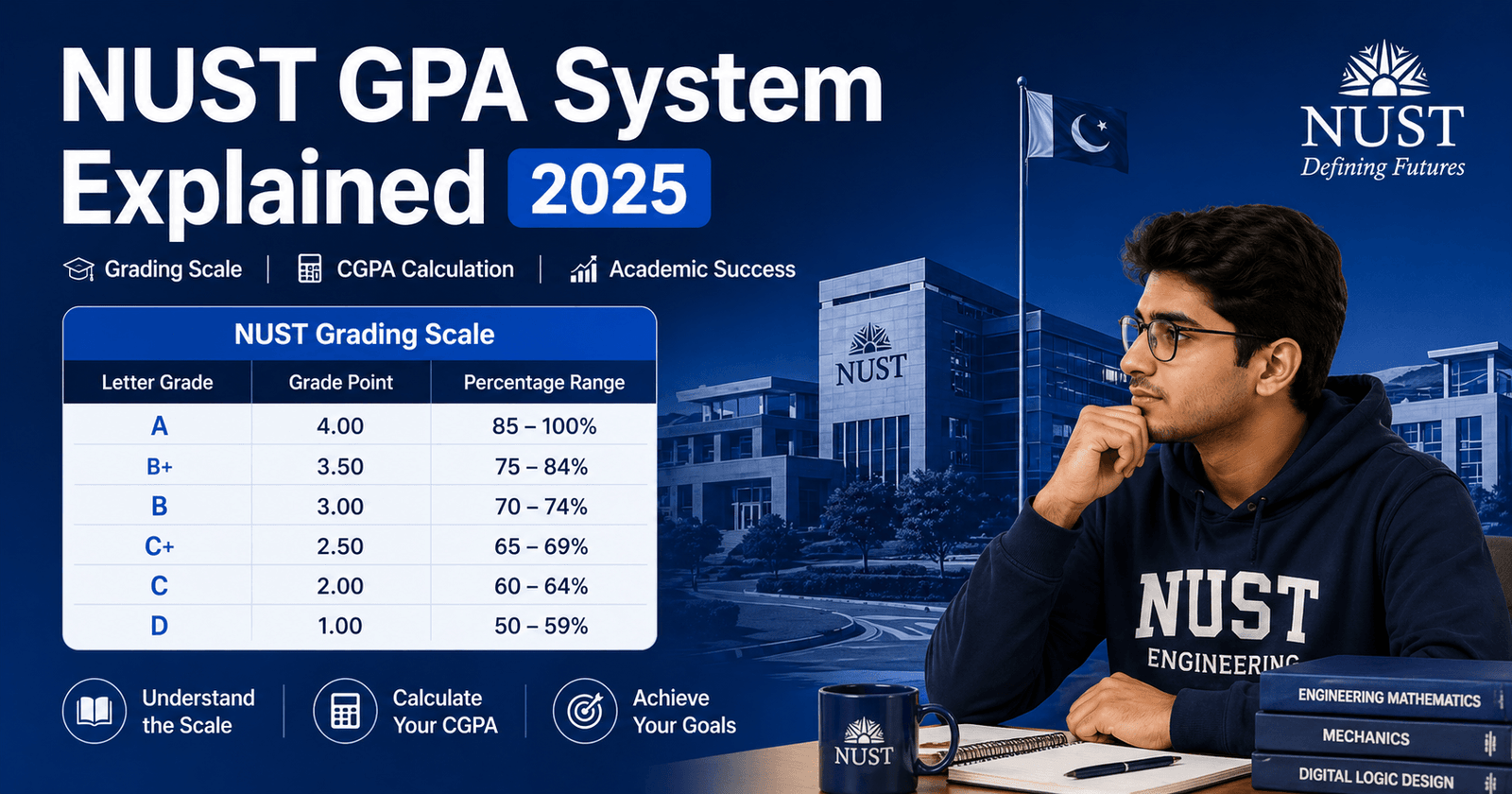
This guide explains everything you need to know about CGPA in Pakistani universities, following the Higher Education Commission (HEC) of Pakistan's grading guidelines and the practices of major institutions including NUST, COMSATS, FAST-NUCES, UET, Punjab University, and Virtual University.
What is CGPA? A Simple Explanation
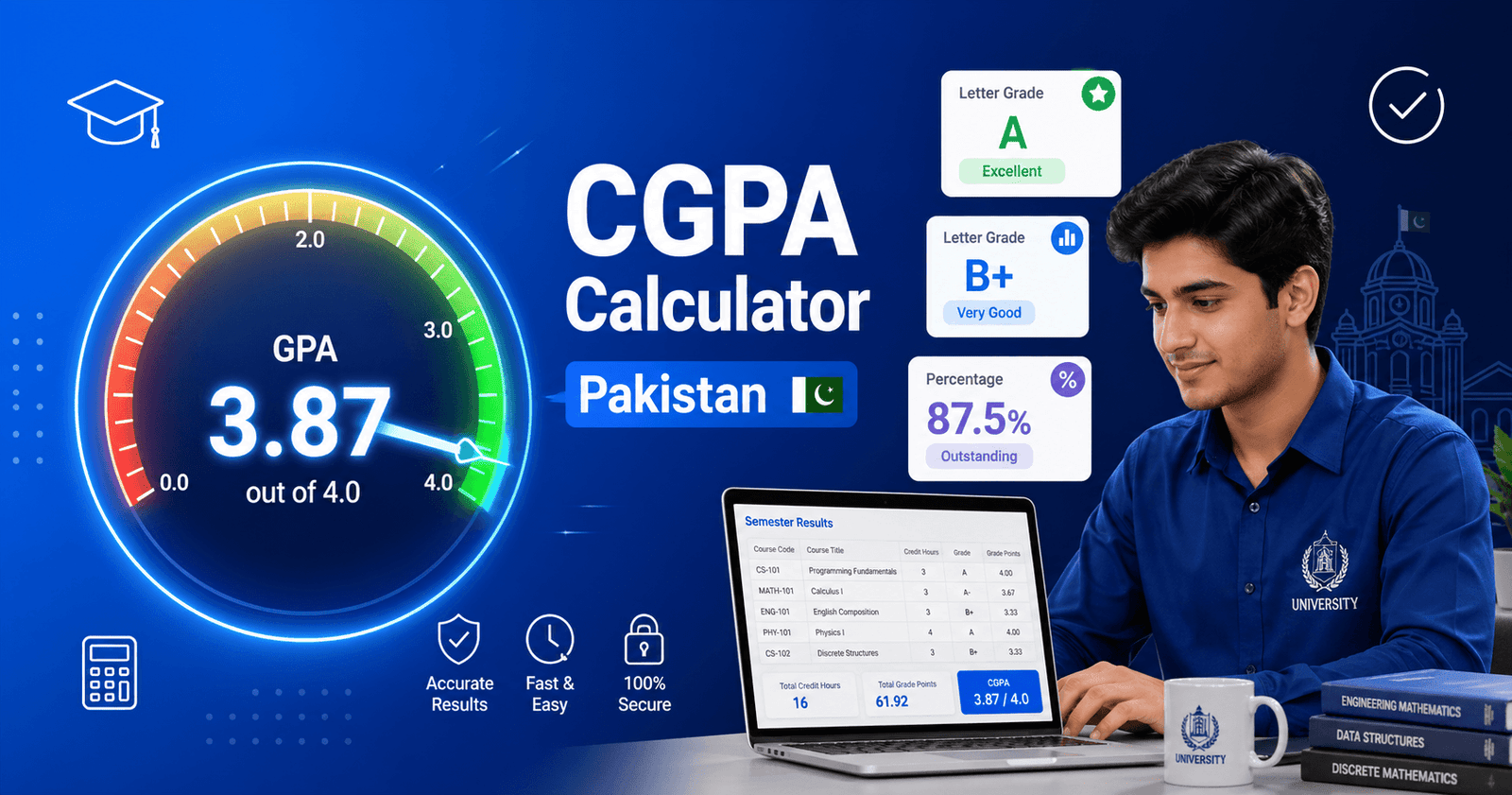
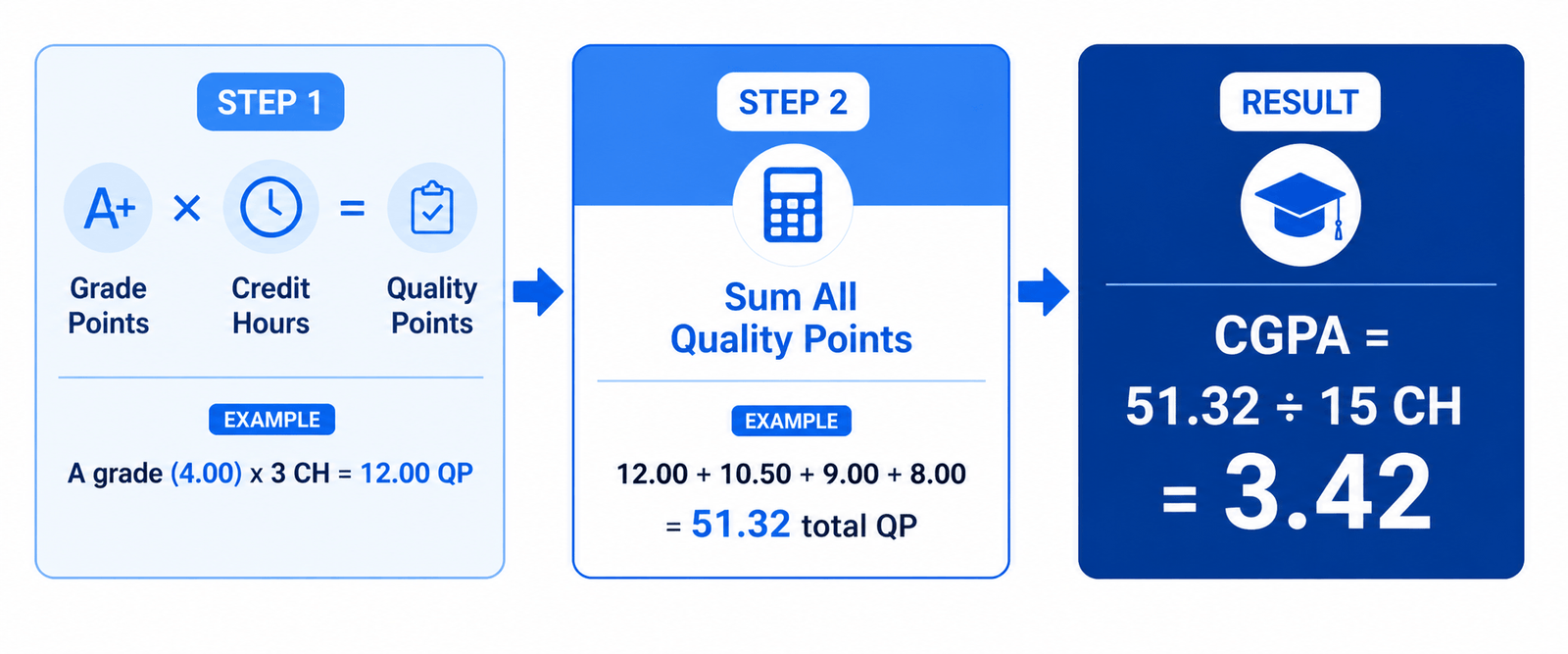
CGPA stands for Cumulative Grade Point Average. It is a weighted average of your semester GPAs, where the weight of each semester is determined by the number of credit hours you completed in that semester. In Pakistan, the CGPA is calculated on a 4.0 scale at virtually all HEC-recognized institutions.
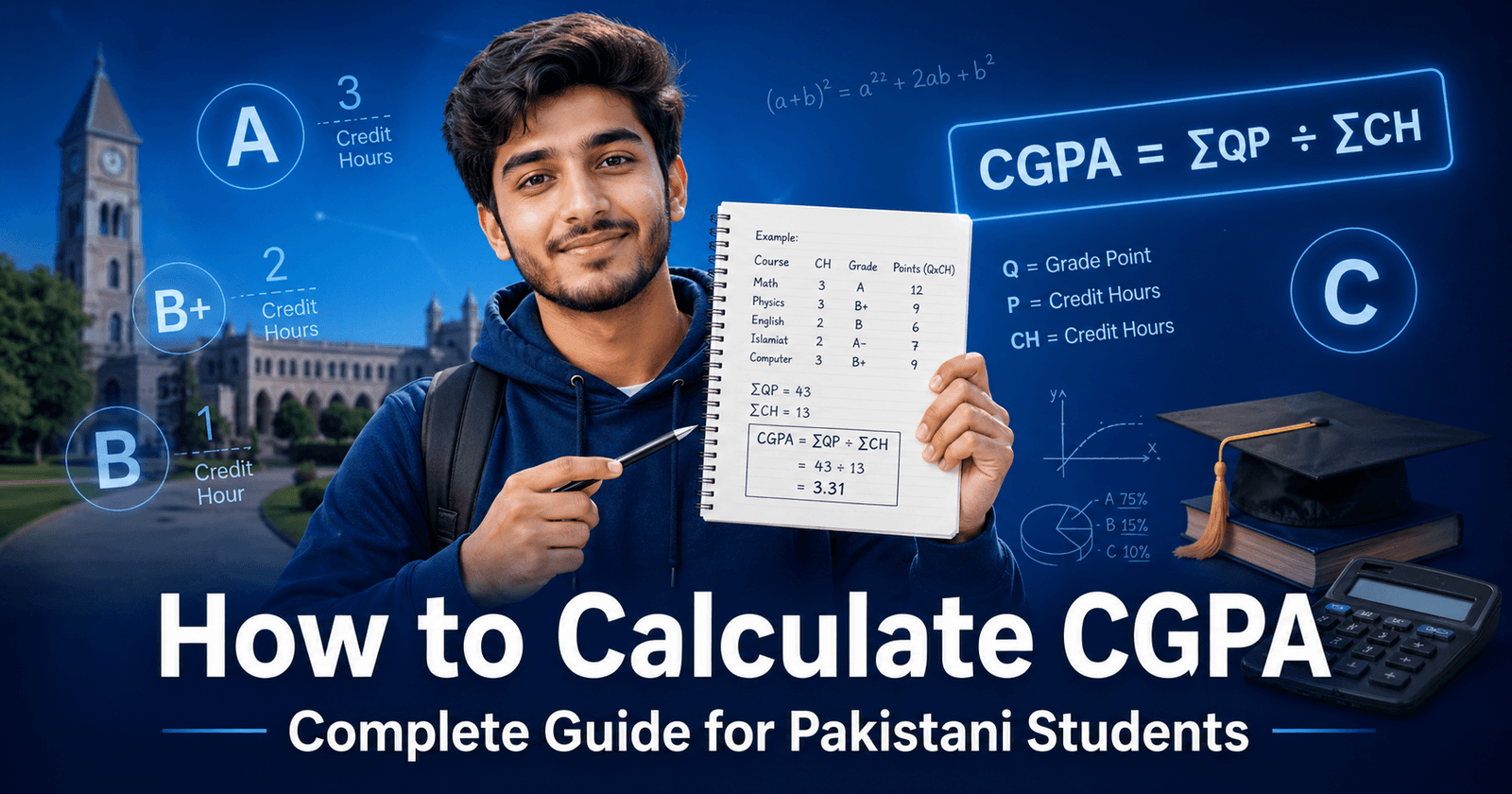
Here is the basic formula:
Where Quality Points = Grade Point × Credit Hours for each subject
For example, if you take five subjects in a semester — Mathematics (3 credit hours, A- grade = 3.67 GP), Physics (3 CH, B+ = 3.33 GP), Programming (3 CH, A = 4.0 GP), English (2 CH, B = 3.0 GP), and Lab (1 CH, A = 4.0 GP) — your calculation would be:
| Subject | Credit Hrs | Grade | GP | Quality Pts |
|---|---|---|---|---|
| Mathematics | 3 | A- | 3.67 | 11.01 |
| Physics | 3 | B+ | 3.33 | 9.99 |
| Programming | 3 | A | 4.00 | 12.00 |
| English | 2 | B | 3.00 | 6.00 |
| Lab | 1 | A | 4.00 | 4.00 |
| Total | 12 | 43.00 |
GPA = 43.00 ÷ 12 = 3.58
HEC Grading Scale in Pakistan
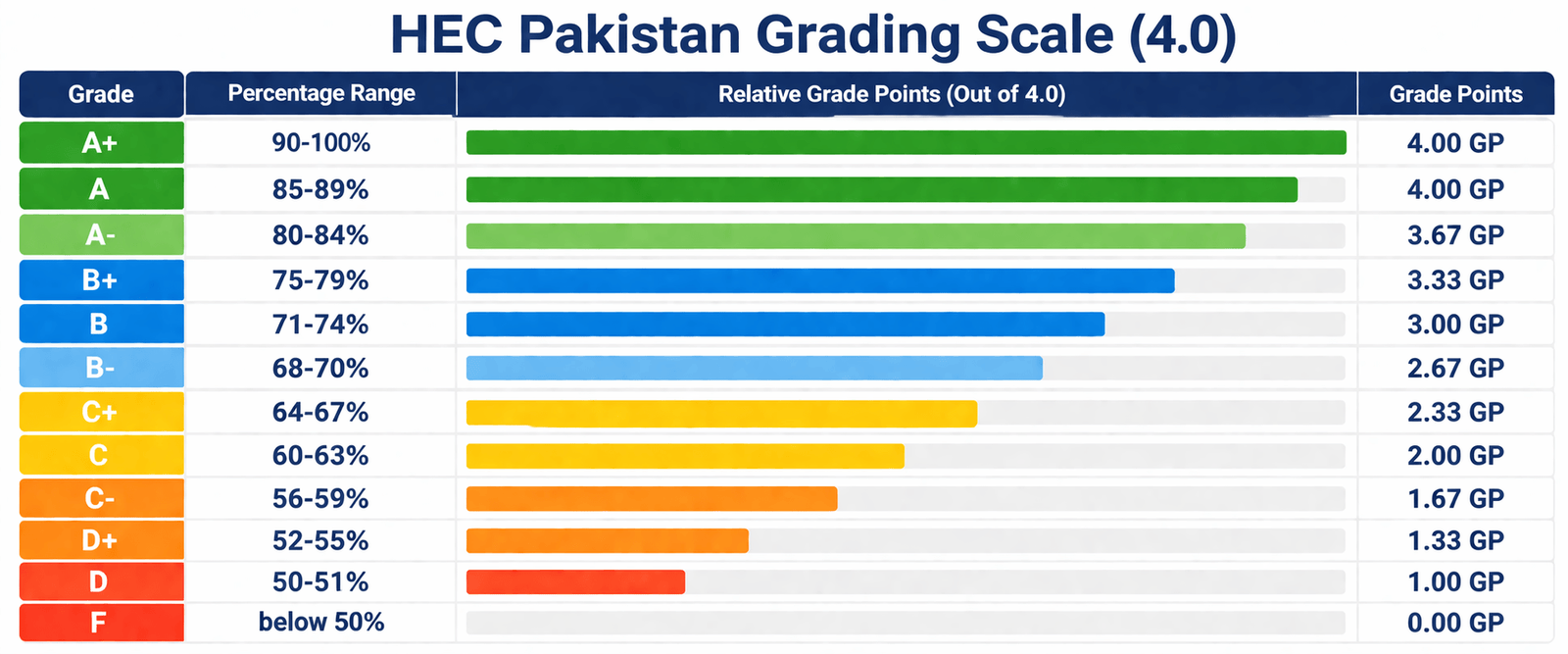
The Higher Education Commission of Pakistan has established a standardized grading scale that most universities follow. This scale maps letter grades to grade points on a 4.0 system:
| Marks (%) | Letter Grade | Grade Points | Description |
|---|---|---|---|
| 90–100 | A+ | 4.00 | Outstanding |
| 85–89 | A | 4.00 | Excellent |
| 80–84 | A- | 3.67 | Very Good |
| 75–79 | B+ | 3.33 | Good |
| 71–74 | B | 3.00 | Above Average |
| 68–70 | B- | 2.67 | Average |
| 64–67 | C+ | 2.33 | Below Average |
| 60–63 | C | 2.00 | Satisfactory |
| 56–59 | C- | 1.67 | Pass |
| 52–55 | D+ | 1.33 | Low Pass |
| 50–51 | D | 1.00 | Minimum Pass |
| Below 50 | F | 0.00 | Fail |
CGPA Ranges and What They Mean
Understanding what your CGPA range means helps you set realistic goals and understand where you stand academically:
- 3.7 – 4.0: Exceptional — typically qualifies for Dean's List, High Honors, Gold Medal consideration, and top scholarship opportunities
- 3.5 – 3.69: Excellent — qualifies for Honors at most universities, strong for MS/PhD admissions
- 3.0 – 3.49: Very Good — above average, competitive for most graduate programs and professional jobs
- 2.5 – 2.99: Good — meets minimum requirements for most graduate programs and job applications
- 2.0 – 2.49: Satisfactory — meets minimum graduation requirements; may limit graduate school options
- Below 2.0: Academic Probation — most universities place students on probation and require improvement
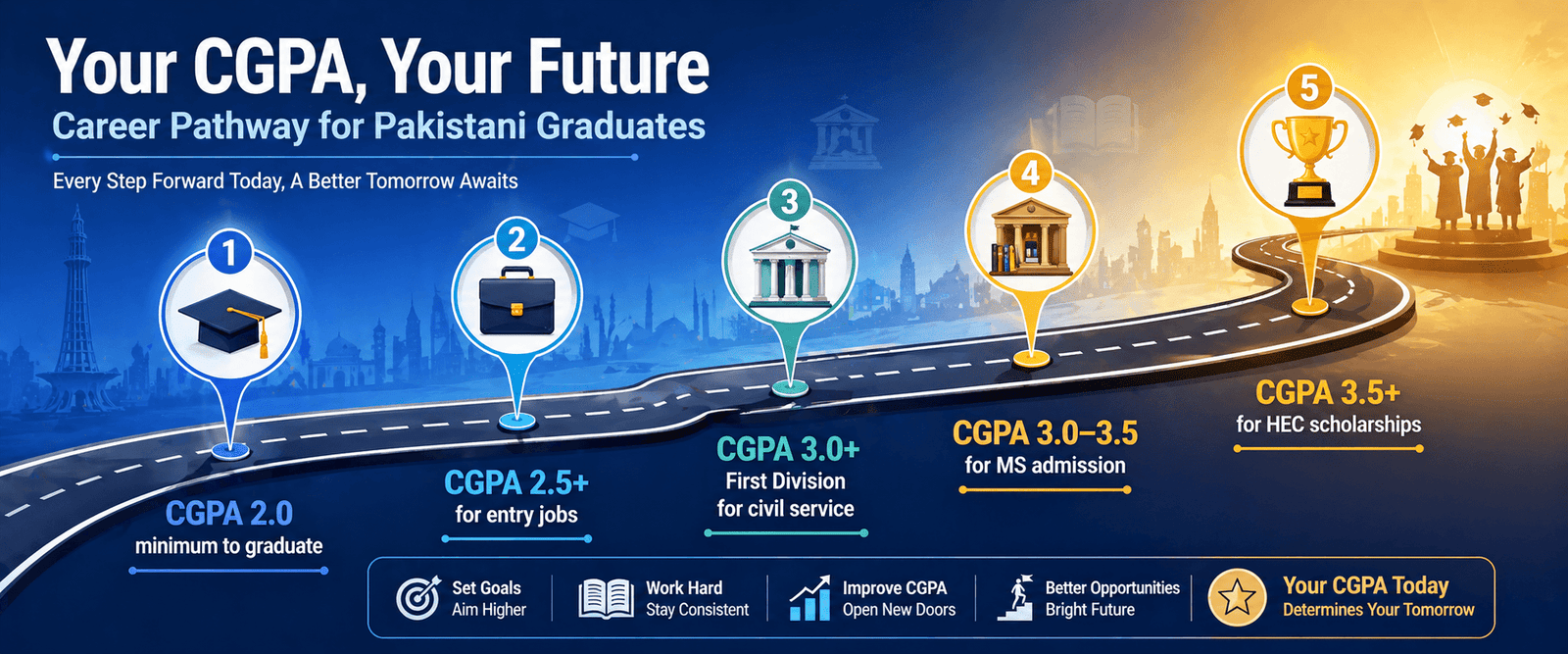
Why Your CGPA Matters Beyond University
Your CGPA is far more than just a number on a transcript. In Pakistan's academic and professional landscape, it plays a crucial role in several key areas:
Graduate School Admissions
For students aspiring to pursue MS, MBA, or PhD programs in Pakistan or abroad, CGPA is a primary screening criterion. HEC scholarships for higher education typically require a minimum CGPA of 2.5, with the most competitive scholarships like the HEC Indigenous 5000 PhD Fellowship requiring 3.0 or higher. International scholarship programs such as those from Fulbright, Chevening, and DAAD also consider your CGPA as part of the application evaluation.
Job Market in Pakistan
Many employers in Pakistan — particularly in banking, telecom, technology, and engineering sectors — explicitly state CGPA requirements in their job listings. Companies like HBL, UBL, Telenor, Jazz, and major engineering firms often set a minimum CGPA of 2.5 or percentage equivalent of 60%. Some premier employers prefer candidates with 3.0 or above. While skills and experience matter, a strong CGPA signals discipline, consistency, and intellectual capability to recruiters.
Government Jobs and CSS
Pakistan's civil service and government sector jobs calculate merit based on a combination of academic marks and test scores. For the CSS examination, educational qualification merit points are calculated based on your degree marks. A first division (60%+ or 3.0+ CGPA) earns more merit points than a second division. This can be the deciding factor in competitive positions with hundreds of applicants.
How to Improve Your CGPA in Pakistan
Improving your CGPA requires a strategic approach, especially if you have many credit hours already completed. Here are proven strategies:
1. Understand the Weight of Credit Hours
Your CGPA is a weighted average. A 4-credit hour course has twice the impact on your CGPA as a 2-credit hour course. Focus extra energy on high-credit-hour subjects, as performing well in these moves your CGPA more significantly.
2. Use the CGPA Improvement Calculator
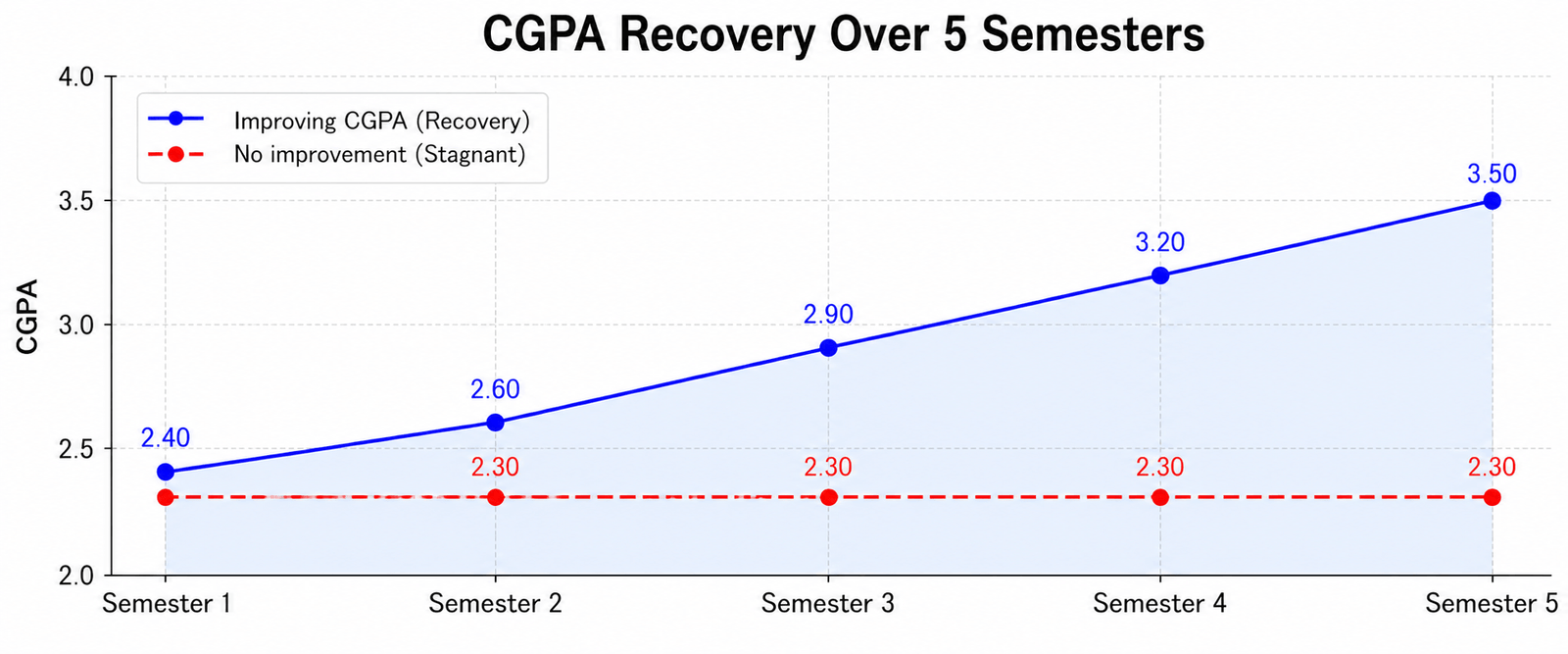
Our free CGPA Improvement Calculator (Tool 6 above) tells you exactly how many credit hours you need to complete at a target GPA to reach your desired CGPA. This removes guesswork and helps you plan realistically.
3. Retake Failing or Low-Grade Courses
Many Pakistani universities allow grade improvement by retaking courses. If your university's policy allows grade replacement (where the new grade replaces the old one in CGPA calculation), retaking a course where you scored D or F can significantly boost your CGPA. Check your university's specific policy on grade replacement.
4. Load Management Strategy
Don't overload yourself with credit hours if you're already struggling. A lighter course load with higher grades will improve your CGPA faster than a heavy load with mediocre results. Quality over quantity is the mantra for CGPA recovery.
5. Seek Academic Support Early
University support systems — tutoring centers, office hours, study groups — exist precisely for students who want to improve. Using these resources early in the semester, rather than during exam crunch time, leads to better outcomes.
Common CGPA Calculation Mistakes
Many students make errors when manually calculating their CGPA. Here are the most common mistakes to avoid:
- Ignoring credit hour weights: Simply averaging letter grades without weighting by credit hours gives a wrong result
- Using the wrong grading scale: Different universities use slightly different grade-to-GP mappings. Always use your specific university's official scale
- Including incomplete or withdrawn courses: Courses marked W (withdrawn) or I (incomplete) are typically not included in CGPA calculations
- Wrong percentage-to-CGPA conversion: There are multiple conversion methods in use; using the wrong one for job applications can misrepresent your academic standing
Our Free CGPA Tools — Your Complete Academic Toolkit
CGPACalc.site provides 10 completely free, accurate academic calculators designed specifically for Pakistani university students. All tools follow HEC guidelines and university-specific grading scales. No registration, no fees, no data collection — just fast and accurate calculations.
Whether you're calculating your semester GPA at COMSATS, checking if your CGPA qualifies you for NUST's Dean's List, converting your CGPA to percentage for a job application, or planning how many credit hours you need to improve your standing — our tools have you covered. Bookmark this page and share it with your fellow students.