
About NUST — Pakistan's Number One University
The National University of Sciences and Technology (NUST), located on H-12 in Islamabad, is Pakistan's consistently top-ranked university and a regional leader in engineering, computer science, and applied sciences research. Founded in 1991, NUST has expanded into a sprawling institution of over 22 constituent schools and colleges, including SEECS (School of Electrical Engineering and Computer Science), SMME (Mechanical and Manufacturing Engineering), SCME (Chemical and Materials Engineering), MCS (Military College of Signals), CAE (College of Aeronautical Engineering), CEME (College of E&ME), SADA (School of Art, Design and Architecture), SNS (School of Natural Sciences), S3H (School of Social Sciences and Humanities), ASAB (Atta-ur-Rahman School of Applied Biosciences), and more.
NUST attracts Pakistan's most academically competitive students through its rigorous NET (NUST Entry Test). Students who earn admission quickly discover that NUST's grading system differs significantly from other Pakistani universities — using a simplified 7-grade scale instead of the HEC standard 12-grade system. Understanding this difference is not optional: using the wrong grading scale produces incorrect CGPA calculations, leading to misinformed academic planning.
This guide covers everything a NUST student needs to know: the complete grading scale, Dean's List requirements, graduation honors, academic probation rules, course repeat policies, CGPA-to-percentage conversion, and proven strategies for CGPA improvement. Whether you're a freshman in your first semester at SEECS or a final-year student at SMME trying to qualify for graduation with distinction, this guide is written for you.
NUST's Unique 7-Grade System — Why It's Different
The fundamental difference between NUST's grading system and the HEC standard used at COMSATS, FAST, IBA, and most other Pakistani universities is the number of grade categories. The HEC standard uses 12 grades (A+, A, A-, B+, B, B-, C+, C, C-, D+, D, F), while NUST uses only 7 broader categories (A, B+, B, C+, C, D, F).
This matters enormously in practice. A student scoring 82% at COMSATS earns an A- (3.67 GP). The same student at NUST earns B+ (3.50 GP) because 82% falls in the 75–84% band. Over a 3-credit course, that's 0.51 fewer quality points — a difference that compounds across an entire degree. Never use a generic HEC calculator for NUST grades. Always use our NUST GPA Calculator which applies the correct scale automatically.
NUST Official Grading Scale 2025
| Marks (%) | Letter Grade | Grade Points | Classification | Quality Pts (3-CH) |
|---|---|---|---|---|
| 85 – 100 | A | 4.00 | Outstanding / Excellent | 12.00 |
| 75 – 84 | B+ | 3.50 | Very Good | 10.50 |
| 70 – 74 | B | 3.00 | Good | 9.00 |
| 65 – 69 | C+ | 2.50 | Above Average | 7.50 |
| 60 – 64 | C | 2.00 | Satisfactory | 6.00 |
| 50 – 59 | D | 1.00 | Low Pass | 3.00 |
| Below 50 | F | 0.00 | Fail | 0.00 |
🟢 Grade A (85–100%): 4.00 Grade Points
NUST's highest grade — covers 85% to 100% with no A+ distinction. Scoring 85% and 100% both earn identical grade points (4.00). Once you cross 85%, additional marks don't improve your GPA. This makes targeting the 85% threshold precisely — not exceeding it — an efficient exam strategy. An A in every 3-credit course contributes 12.00 quality points per course.
🔵 Grade B+ (75–84%): 3.50 Grade Points
The most strategically important grade at NUST. The B+ covers a wide 10-mark range (75–84%). The jump from B (3.00) to B+ (3.50) at the 75% threshold adds 0.50 GP per credit hour — 1.50 quality points on a 3-credit course. A student who scores 75% in all five 3-credit courses per semester earns a GPA of 3.50. B+ grades across all courses produce a GPA well above 3.0 but still below Dean's List (3.70).
🔵 Grade B (70–74%): 3.00 Grade Points
A grade of B is solid middle-ground performance at NUST. The B covers only a 5-mark range (70–74%). Consistently earning B grades across a semester produces a GPA of 3.00 — "First Division" territory for job applications and graduate admissions. However, a mix of B and C+ grades quickly drags the GPA toward 2.75, which limits graduate school options.
🟡 Grade C+ (65–69%): 2.50 Grade Points
The C+ is the danger zone at NUST. Dropping from B (3.00) to C+ (2.50) loses 0.50 GP per credit hour — 1.50 quality points on a 3-credit course. A pattern of C+ grades will keep your CGPA in the 2.5 range, which limits access to scholarships, competitive graduate programs, and some employer screening filters. The goal should be to minimize C+ grades by staying above 70% in every course.
🟡 Grade C (60–64%): 2.00 Grade Points
Grade C is the minimum satisfactory performance. A C in a 4-credit course contributes only 8.00 quality points versus 16.00 for an A — a difference of 8.00 quality points. Recovering from multiple C grades requires consistently high performance in subsequent courses. The C-D boundary at 60% is NUST's most dangerous single threshold.
🔴 Grade D (50–59%): 1.00 Grade Point
The D grade is NUST's most devastating non-failing grade. It earns only 1.00 GP and covers a 10-mark range (50–59%). The drop from C (2.00) to D (1.00) at the 60% boundary represents a loss of 1.00 GP per credit hour — 3.00 quality points on a 3-credit course. Avoid D grades even more urgently than F grades, because an F at least signals the need for immediate action while a D can slip under the radar while quietly destroying your GPA.
🔴 Grade F (Below 50%): 0.00 Grade Points
A failing grade requires course repetition. An F contributes 0 quality points while still counting in the CGPA denominator, actively pulling your average down. Retake failed courses as early as possible — even earning a D (1.00 GP) on retake more than doubles the quality points contributed by that course slot.
Complete GPA Calculation Example — NUST Semester 3
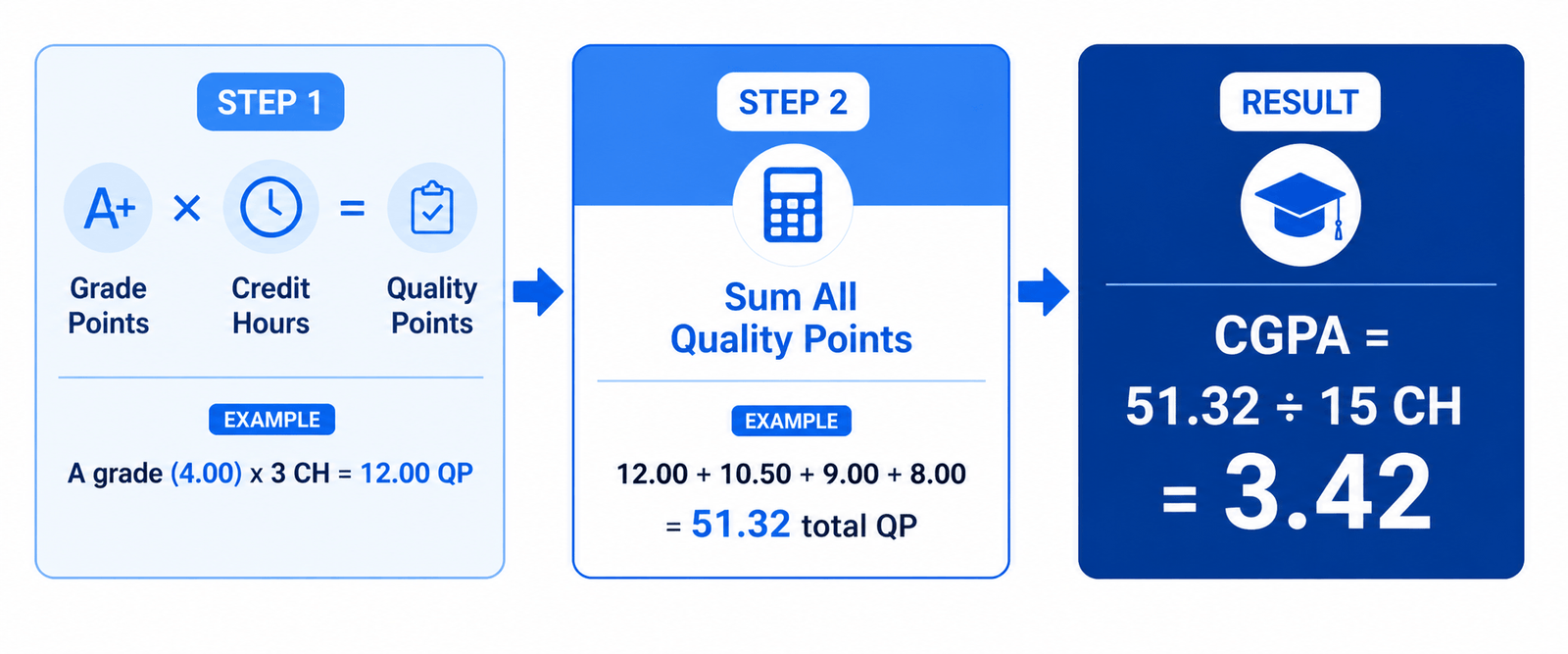
Using the NUST grading scale, here is a complete semester GPA calculation for a SEECS Computer Science student:
| Course | Credit Hrs | Marks % | Grade | GP | Quality Points |
|---|---|---|---|---|---|
| Data Structures & Algorithms | 3 | 87 | A | 4.00 | 12.00 |
| Computer Architecture | 3 | 79 | B+ | 3.50 | 10.50 |
| Probability & Statistics | 3 | 71 | B | 3.00 | 9.00 |
| Communication Skills | 2 | 90 | A | 4.00 | 8.00 |
| Discrete Mathematics | 3 | 67 | C+ | 2.50 | 7.50 |
| DS Lab | 1 | 85 | A | 4.00 | 4.00 |
| Pakistan Studies | 2 | 88 | A | 4.00 | 8.00 |
| TOTAL | 17 | — | — | — | 59.00 |
Semester GPA = 59.00 ÷ 17 = 3.47
Analysis: This is a solid GPA — above First Division threshold — but falls short of NUST's 3.70 Dean's List requirement. The C+ in Discrete Mathematics (67%, 2.50 GP) is the biggest drag. Improving it to B+ (75%+, 3.50 GP) would add 3.00 extra quality points, pushing the GPA to approximately 3.65 — still just below Dean's List. Raising Discrete Mathematics to an A (85%+) would add 4.50 quality points and push the GPA to 3.73 — qualifying for Dean's List.
NUST Dean's List — Complete Requirements for 2025
The NUST Dean's List is one of the most prestigious semester recognitions a Pakistani university student can earn. It is noted permanently on your transcript and carries significant weight with employers and graduate schools who are familiar with NUST's high academic standards.
To qualify for the NUST Dean's List in any given semester, a student must satisfy ALL of the following conditions simultaneously:
- Minimum semester GPA: 3.70 out of 4.00 — NUST's threshold is among the highest of any Pakistani university
- Full-time enrollment: Must be registered for the full credit hour load for your program (typically 15–18 CHs per semester depending on program year)
- No F grade: Zero failing grades in any registered course during that semester
- No Incomplete (I) grade: All course grades must be finalized — any outstanding I grade disqualifies the semester
- No academic misconduct: Must not be under any active disciplinary case, plagiarism charge, or academic integrity proceeding
- Not on academic probation: Students on probation are ineligible for Dean's List regardless of their semester GPA
The Dean's List is announced at the end of each fall and spring semester. Students receive a certificate from their School's Dean and a permanent notation on their official transcript reading "Dean's Honor Roll — [Semester, Year]." Students who make the Dean's List in five or more semesters typically receive special recognition at convocation.
Graduation Honors at NUST
| Cumulative CGPA | Latin Honor | Award | Rarity |
|---|---|---|---|
| 3.90 – 4.00 | Summa Cum Laude | Gold Medal from NUST Rector | Extremely rare (<1%) |
| 3.70 – 3.89 | Magna Cum Laude | Silver Medal at Convocation | Rare (1–3%) |
| 3.50 – 3.69 | Cum Laude / Distinction | Distinction on Degree Certificate | Uncommon (5–10%) |
| 3.00 – 3.49 | High Performance | Commencement recognition | Common (20–30%) |
| 2.00 – 2.99 | — | Standard Degree | Majority of graduates |
NUST Academic Probation — Rules and Recovery Path
NUST's probation system is designed to identify struggling students early and give them structured support for recovery. Understanding the system helps you respond quickly and decisively if your CGPA dips below the minimum.
Probation is triggered when a student's cumulative CGPA falls below 2.00 at the end of any semester. The school's academic office issues a formal probation notice within the first week of the following semester. Students on probation face the following conditions:
- Mandatory weekly academic counseling sessions with an assigned advisor
- Restricted course registration — typically capped at 12–15 credit hours per semester during probation
- Suspension of merit scholarships and NUST financial assistance
- Prohibition from holding leadership positions in NUST student societies
- Ineligibility for Dean's List regardless of semester GPA achieved during probation
- Required academic improvement plan submitted and approved by school Head of Department
Probation duration: Students have two consecutive semesters to raise their cumulative CGPA above 2.00. If successful, probation status is lifted at the end of the second semester. If unsuccessful, the student may be referred for academic dismissal.
Academic dismissal is not automatic — students receive formal notice and have the right to appeal to NUST's Academic Review Committee. Successful appeals typically require documented evidence of serious extenuating circumstances (severe illness, bereavement, documented mental health crisis) that directly impacted academic performance during the semesters in question.
NUST Course Repeat Policy
NUST allows students to repeat failed courses and, in most constituent schools, courses where they received a D grade. Key points:
- The new grade replaces the original grade in CGPA calculation under NUST's grade replacement policy (verify with your specific school)
- The original failing or low grade remains visible on the transcript with an "R" (Repeated) notation
- Transcript transparency means graduate schools and employers can see that a course was repeated
- Normal maximum credit hour limits per semester still apply to repeat enrollments
- Repeating a course where you earned D (1.00 GP) and improving to B+ (3.50 GP) adds 2.50 quality points per credit hour — on a 3-credit course, that's +7.50 quality points toward your cumulative total
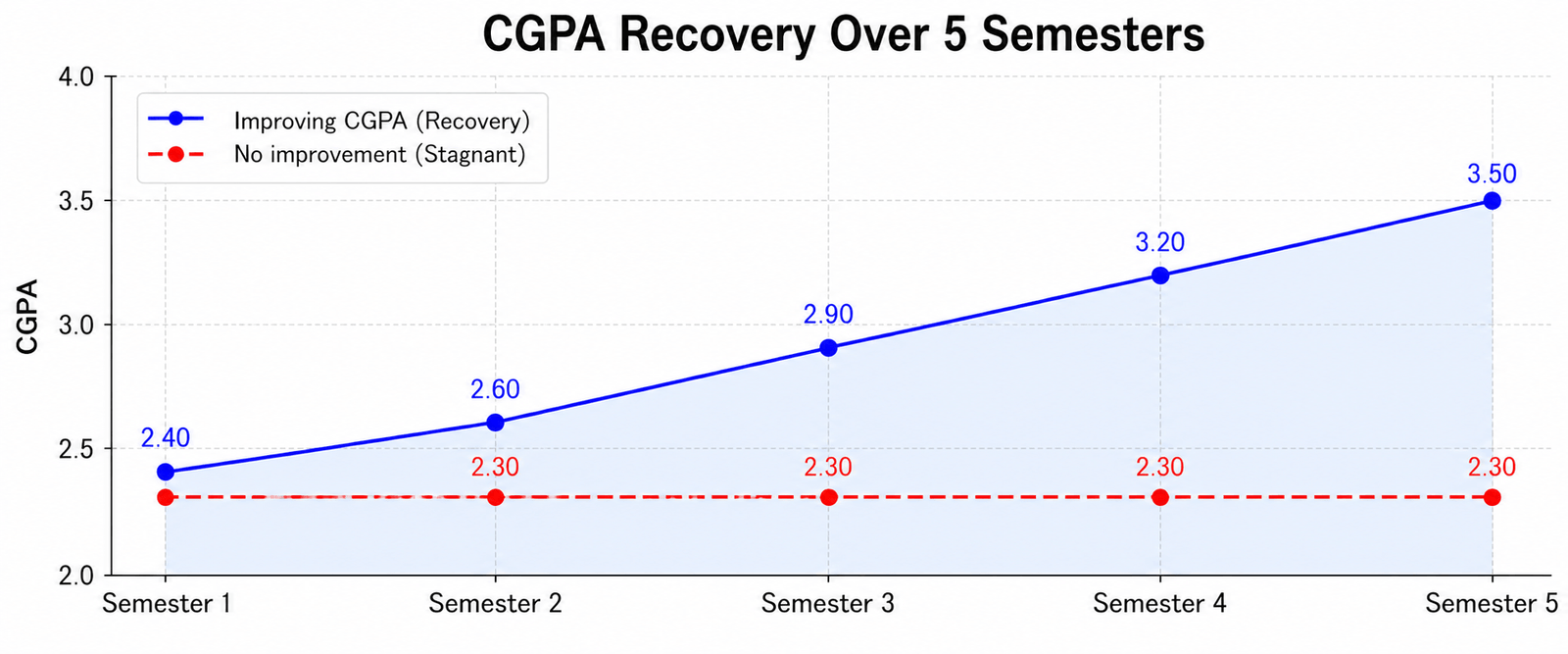
CGPA Improvement Chart — Visualizing Recovery
NUST vs Other Pakistani Universities — Grading Comparison
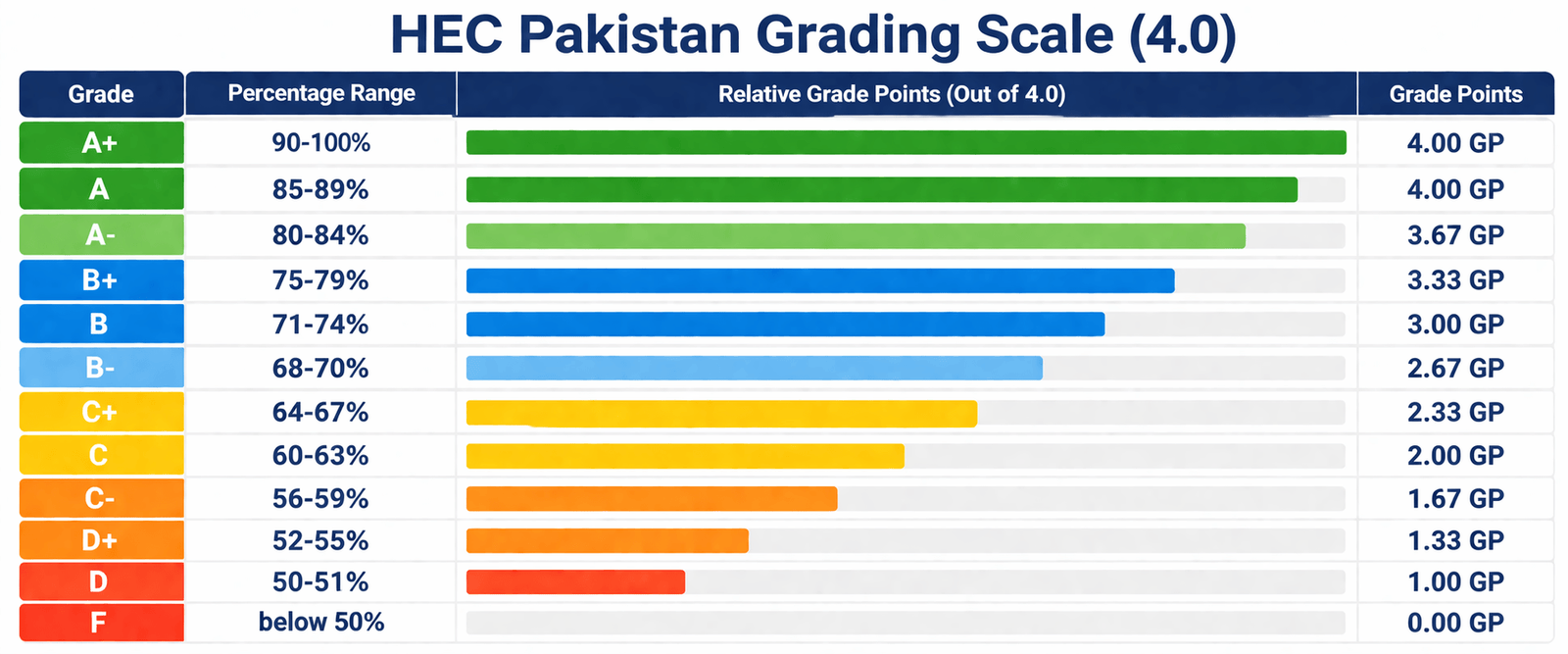
The comparison above highlights how the same underlying marks percentage produces different grade points across Pakistani universities. This is particularly relevant for students who transfer between universities or who compare their CGPA with peers at other institutions:
| University | Grade System | 80% → GP | 72% → GP | Dean's List |
|---|---|---|---|---|
| NUST | 7-grade | B+ = 3.50 | B = 3.00 | 3.70+ |
| COMSATS/FAST | 12-grade | A- = 3.67 | B = 3.00 | 3.50+ |
| UET Lahore | 6-grade | A = 4.00 | B = 3.00 | 3.50+ |
| Punjab Uni | Modified HEC | A = 4.00 | B = 3.00 | 3.50+ |
NUST CGPA to Percentage Conversion
For government job applications, CSS, FPSC, and international graduate school admissions, you may need to present your CGPA as a percentage. The standard conversion used across Pakistan:
Examples:
3.90 CGPA → 97.5% (Distinction)
3.70 CGPA → 92.5% (First Division with Distinction)
3.40 CGPA → 85.0% (First Division)
3.00 CGPA → 75.0% (First Division)
2.50 CGPA → 62.5% (Second Division)
For official submissions, request a percentage equivalence certificate from NUST's Registrar Office. Use our CGPA to Percentage Converter for instant estimates.
NUST Minimum CGPA Requirements — Complete Reference Table
| Purpose | Min. CGPA | Notes |
|---|---|---|
| Graduation (all programs) | 2.00 | Mandatory minimum |
| MS Admission (NUST internal) | 2.50 | Competitive: 3.0+ |
| PhD Admission (NUST) | 3.00 (from MS) | Competitive: 3.5+ |
| Dean's List (per semester) | 3.70 GPA | Semester GPA, not cumulative |
| Cum Laude / Distinction | 3.50 | Cumulative at graduation |
| Magna Cum Laude / Silver Medal | 3.70 | Cumulative at graduation |
| Summa Cum Laude / Gold Medal | 3.90 | Cumulative; per program |
| Academic Probation Trigger | Below 2.00 | 2 semesters to recover |
| HEC Overseas Scholarship | 3.00 | Competitive: 3.5+ |
| Fulbright Scholarship | 3.00 | Competitive: 3.5+ with experience |
6 Proven Strategies to Improve Your NUST CGPA
📊 Use the NUST Calculator
Our GPA Calculator (select NUST) uses the correct 7-grade scale. Track your semester GPA after every assessment to monitor your standing in real time.
🎯 Target the 75% & 85% Boundaries
These two marks thresholds yield the biggest GP jumps at NUST. Before each exam, calculate exactly what marks you need to cross the next boundary. This turns vague "study harder" into a concrete marks target.
📅 Attend Office Hours Early
NUST faculty regularly hold office hours. Visit in Weeks 2–3, not Week 14. Early rapport leads to better understanding, clarified doubts, and sometimes benefits on borderline assignments.
📈 Calculate Your Recovery Plan
Use our CGPA Improvement Calculator to find out exactly how many credit hours at what GPA you need to reach your target CGPA. Numbers-driven planning beats vague hope.
🔁 Retake D-Grade Courses
Retaking a D (1.00 GP) and earning B+ (3.50 GP) adds 2.50 quality points per credit hour. On a 3-CH course: +7.50 QPs. Summer semester is ideal for strategic retakes.
📚 Form Study Groups
NUST's top students consistently use collaborative study groups, especially for mathematics and theory-heavy courses. Teaching concepts to others deepens your own understanding and exam readiness.
Frequently Asked Questions — NUST Grading 2025
What is a good CGPA at NUST?
A CGPA of 3.0+ is considered good at NUST and qualifies you for most graduate programs and competitive employers. 3.5+ earns Distinction at graduation. 3.7+ qualifies for the Dean's List each semester. Even a 2.8–3.0 CGPA at NUST represents solid performance given the university's rigorous standards.
Can I improve my NUST CGPA in my final year?
Yes. The impact depends on remaining credit hours. With 30+ CHs remaining, a consistent 3.80 GPA can move your CGPA significantly. Use our CGPA Improvement Calculator to model this precisely.
Is NUST's grading scale harder than COMSATS or FAST?
At the 80% marks level, yes — NUST gives 3.50 GP (B+) while COMSATS gives 3.67 GP (A-). International programs and employers familiar with NUST generally account for this when evaluating transcripts.
Does NUST have a summer semester for CGPA recovery?
Yes. NUST offers summer semesters (June–July) with a maximum of 9 credit hours. Summer is an excellent time for retaking D or F courses to improve your CGPA in a lighter academic environment.
How does NUST CGPA compare internationally?
NUST's 4.0 scale is understood by international universities and WES credential evaluators. A NUST CGPA of 3.0+ is generally equivalent to a US GPA of 3.0+ and a UK Upper Second Class (2:1), making NUST graduates competitive for international graduate admissions.