
NUST — the National University of Sciences and Technology — is Pakistan's consistently top-ranked university and one of Asia's most respected research institutions. Every year, tens of thousands of students compete intensely for NUST admission through its merit-based NET (NUST Entry Test), and those who earn a seat quickly discover that the academic environment inside matches the selectivity of the entrance process.
At the heart of navigating NUST's demanding academics is understanding one crucial fact: NUST uses a grading system that is fundamentally different from every other major Pakistani university. While COMSATS, FAST, IBA, and most HEC-accredited institutions use a 12-grade system with grades like A-, B+, B, B-, C+, C, C-, etc., NUST uses a simplified 7-grade system with only seven distinct grade categories. This difference has far-reaching implications for GPA calculation, Dean's List eligibility, scholarship thresholds, and graduate school competitiveness.
This comprehensive guide explains every aspect of NUST's grading system — the complete grade scale, how GPA is calculated with worked examples from each major NUST school, Dean's List requirements and what they mean practically, graduation honors, academic probation rules, course repeat policies, CGPA-to-percentage conversion, and detailed strategies for NUST-specific CGPA improvement. Whether you're a SEECS freshman or a fourth-year SMME student, this guide is written specifically for you.
Part 1: NUST's Unique Position in Pakistani Higher Education
Why NUST Stands Apart Academically
NUST's reputation is built on several factors that distinguish it from other Pakistani universities. First, NUST consistently ranks in the top 400 globally in QS World University Rankings and is the highest-ranked Pakistani university in most international ranking systems. Second, NUST has a strong research culture — its faculty publish in top international journals and its students participate in significant funded research projects. Third, NUST's constituent schools span an unusually diverse range of disciplines, from advanced electrical engineering and computer science to social sciences, architecture, arts, and biosciences.
NUST attracts Pakistan's most academically competitive students through its rigorous NET examination, which tests mathematics, physics, English, and intelligence — depending on the program applied for. The NET is entirely separate from FSc/A-Level results, meaning students with stellar board results but poor NET performance do not gain admission. Conversely, students who perform exceptionally on the NET can gain admission even with somewhat lower board results. This test-centric admission creates a student body that is exceptionally strong in analytical and quantitative reasoning.
Once enrolled, NUST students quickly discover that maintaining high grades requires consistent effort, strong mathematical foundations, and effective time management. The average GPA at most NUST schools (particularly SEECS, SMME, SCME) hovers around 2.8–3.2 for BS programs — significantly lower than what the same students would likely achieve at less rigorous institutions. A 3.5+ CGPA at NUST is genuinely exceptional and represents sustained top-tier academic performance.
NUST's 22 Constituent Schools — An Overview
NUST is not a single homogeneous entity but a federation of 22 constituent schools, colleges, and institutes. Each school has its own academic culture, faculty composition, and average GPA norms:
| School | Abbreviation | Key Programs | Typical Avg Sem GPA |
|---|---|---|---|
| School of Electrical Engineering & CS | SEECS | EE, CS, SE, AI, DS | 2.85 – 3.25 |
| School of Mechanical & Manufacturing Engineering | SMME | Mechanical, Manufacturing, Industrial | 2.80 – 3.20 |
| School of Chemical & Materials Engineering | SCME | Chemical, Materials, Petroleum | 2.85 – 3.25 |
| School of Civil & Environmental Engineering | SCEE | Civil, Environmental | 3.00 – 3.40 |
| Military College of Signals | MCS | Telecom, CS, EE | 2.90 – 3.30 |
| College of Aeronautical Engineering | CAE | Aero, Avionics | 2.80 – 3.15 |
| College of E&ME | CEME | Mechatronics, Electronic | 2.85 – 3.20 |
| School of Natural Sciences | SNS | Physics, Math, Chemistry, Bio | 2.80 – 3.30 |
| NUST Business School | NBS | BBA, MBA | 3.10 – 3.50 |
| School of Social Sciences & Humanities | S3H | Economics, Psychology, Sociology | 3.15 – 3.55 |
| School of Art, Design & Architecture | SADA | Architecture, Design | 3.00 – 3.45 |
| Atta-ur-Rahman School of Applied Biosciences | ASAB | Biosciences, Biotechnology | 3.00 – 3.40 |
The differences in average GPA across schools reflect the varying difficulty levels and grading cultures. A 3.2 CGPA at SEECS (where average is around 3.0) represents stronger relative performance than a 3.2 CGPA at S3H (where average is around 3.3). When comparing NUST CGPAs for graduate admissions or job applications, context matters.
Part 2: NUST's Official Grading Scale — Complete Breakdown
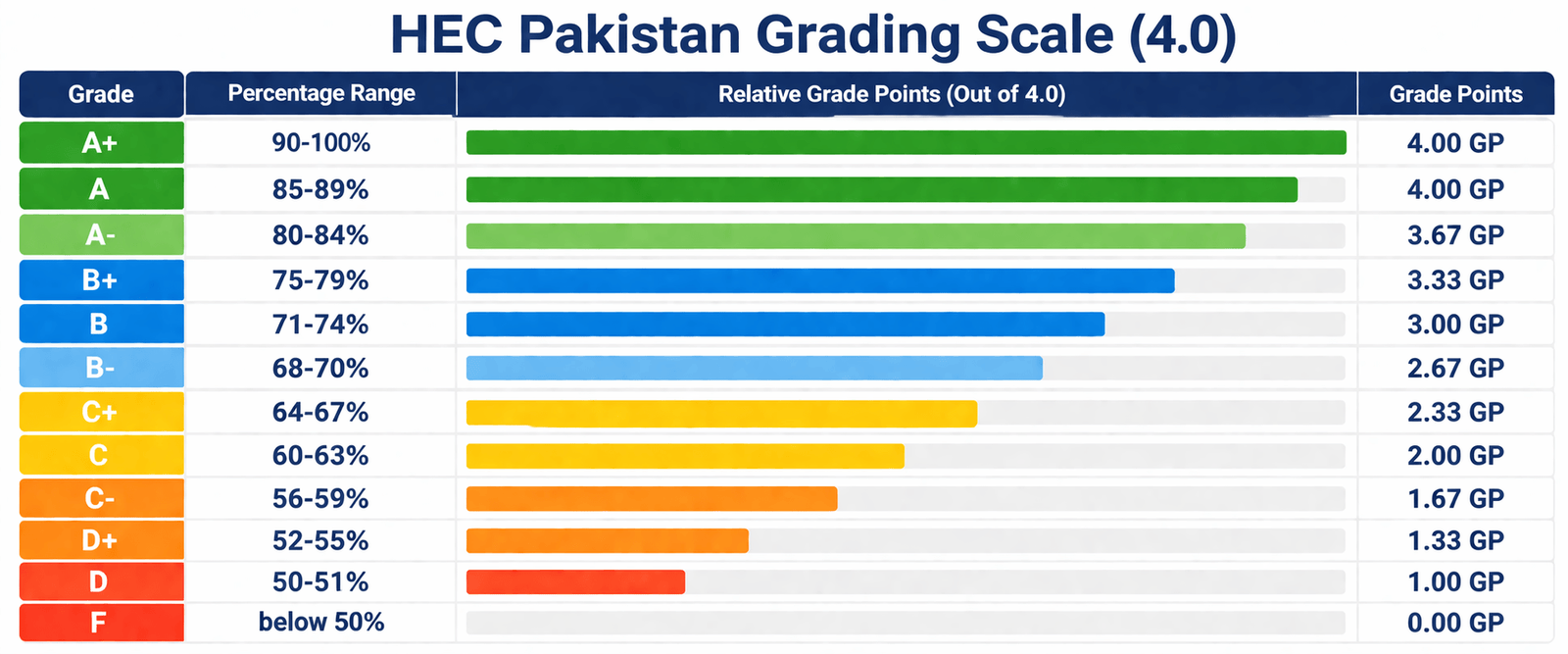
NUST's 7-grade system uses the following official grade-to-point mapping:
| Marks % | Letter Grade | Grade Points | Classification | QP (1-CH) | QP (3-CH) | QP (4-CH) |
|---|---|---|---|---|---|---|
| 85 – 100 | A | 4.00 | Outstanding/Excellent | 4.00 | 12.00 | 16.00 |
| 75 – 84 | B+ | 3.50 | Very Good | 3.50 | 10.50 | 14.00 |
| 70 – 74 | B | 3.00 | Good | 3.00 | 9.00 | 12.00 |
| 65 – 69 | C+ | 2.50 | Above Average | 2.50 | 7.50 | 10.00 |
| 60 – 64 | C | 2.00 | Satisfactory | 2.00 | 6.00 | 8.00 |
| 50 – 59 | D | 1.00 | Low Pass | 1.00 | 3.00 | 4.00 |
| Below 50 | F | 0.00 | Fail | 0.00 | 0.00 | 0.00 |
Deep Dive: Each NUST Grade and Its Strategic Implications
🟢 Grade A (85–100%): 4.00 Grade Points — The Maximum
NUST's A grade covers a wide 16-mark range from 85% to 100%. There is no A+ distinction — scoring 85% and scoring 100% both earn exactly 4.00 grade points and contribute identical quality points to your GPA. This has a critical strategic implication: once you have crossed the 85% threshold in a course, additional marks earn you nothing in terms of GPA. Your study energy is better redirected to courses where you haven't yet reached 85% — particularly those where you're close to the B+ (75%) threshold.
In a typical NUST semester, earning A grades in most courses requires genuinely strong performance — professors are generally strict in marking, and 85%+ is not considered trivial. However, in some courses with generous marking schemes or easier final examinations, A grades are more accessible. Identify these courses in advance through senior students and faculty reputation — legitimate academic strategy, not corner-cutting.
🔵 Grade B+ (75–84%): 3.50 Grade Points — The Dean's List Gateway
NUST's B+ grade covers a 10-mark range from 75% to 84%. At 3.50 GP, B+ is 0.50 grade points below A. On a 3-credit course, the difference between B+ (10.50 QP) and A (12.00 QP) is 1.50 quality points — significant but not catastrophic. The B+ is the most strategically important grade at NUST because it sits at the boundary of Dean's List territory. A semester of all B+ grades earns exactly 3.50 GPA — but you need 3.70 for Dean's List, meaning you need some A grades mixed in.
The 75% threshold (crossing from B to B+) is arguably NUST's most impactful grade boundary. Crossing it adds 0.50 GP per credit hour — equivalent to 1.50 quality points on a 3-credit course. A student who consistently stays above 75% in every course can maintain a 3.50 GPA, which is solid if not spectacular. Those who push multiple courses above 85% can reach Dean's List. Those who fall below 75% in multiple courses see their GPA drop toward the 3.0 range.
🔵 Grade B (70–74%): 3.00 Grade Points — The Solid Middle
The B grade covers a narrow 5-mark range (70–74%) and earns 3.00 GP. A semester of all B grades yields exactly a 3.00 GPA — the first-division threshold for government job merit calculations. B grades are common among solid but not exceptional NUST students. The key danger of B grades is that they can mask a vulnerability: a student averaging 72% across all courses (firmly in B territory at NUST) has very little buffer before falling to C+ (65–69%).
The 70% threshold (B to B+) is significant: crossing it adds 0.50 GP per credit hour. The 70% line is thus a critical improvement target for students with current marks in the 65–69% range. Moving from C+ (2.50 GP) to B (3.00 GP) to B+ (3.50 GP) represents a systematic improvement path that can move CGPA from the low 2s to the high 3s over multiple semesters.
🟡 Grade C+ (65–69%): 2.50 Grade Points — The Warning Zone
A C+ at NUST earns 2.50 GP and covers the 65–69% marks range. C+ grades are problematic because they sit well below Dean's List territory and represent a meaningful drag on cumulative CGPA. A pattern of C+ grades across multiple courses in a semester will produce a GPA around 2.50 — adequate for graduation but limiting for scholarships, graduate school, and competitive employers.
The most important transition to make from C+ is to B (70%+). This adds 0.50 GP per credit hour and significantly improves your GPA trajectory. Students in the C+ zone should identify specific topics within each course where they are losing marks most — in SEECS programs, this is often Mathematics-heavy components; in SMME, it may be thermodynamics or fluid mechanics theory.
🟡 Grade C (60–64%): 2.00 Grade Points — Minimum Satisfactory
A C grade (60–64%) earns 2.00 GP — exactly at the "satisfactory" threshold. C grades are not uncommon in first-year NUST students taking foundational engineering courses (Engineering Mathematics, Applied Physics) for the first time after FSc. Two or three C grades in a semester can push your GPA to around 2.50–2.80, which is below the threshold for many competitive opportunities but above academic probation territory.
The most urgent priority for any student with C grades is preventing them from becoming D grades. The 60% boundary (C to D) represents a massive 1.00 GP cliff. Falling below 60% costs you 1.00 GP per credit hour — the equivalent of going from C (6.00 QP on 3-CH course) to D (3.00 QP) — a loss of 3.00 quality points in a single course. Protect the 60% floor above all other academic objectives.
🔴 Grade D (50–59%): 1.00 Grade Point — Dangerous Territory
NUST's D grade is uniquely devastating compared to the HEC standard scale. While COMSATS and FAST have D+ (1.33 GP) and D (1.00 GP), NUST has only a single D grade covering the entire 50–59% range at 1.00 GP. This means a student scoring 59% earns the same 1.00 GP as one scoring 50% — a very low return for what is actually near-passing performance.
More critically, the D grade can accumulate quietly across multiple courses without triggering automatic probation (which requires cumulative CGPA below 2.00), while still severely dragging down the GPA. A student with two D grades in 3-credit courses (6.00 QP) and three B grades (27.00 QP) on a 15-credit semester earns a GPA of 33/15 = 2.20 — barely above probation territory. Eliminate D grades as the highest academic priority.
🔴 Grade F (Below 50%): 0.00 Grade Points — Course Failure
An F grade at NUST means the course must be retaken. F grades contribute zero quality points while remaining in the denominator of the CGPA calculation until the course is retaken (at which point the new grade replaces the F). A single F in a 4-credit Engineering Mathematics course pulls your quality points to zero for those 4 credit hours — equivalent to earning four courses of A grades being completely negated. Retake failed courses at the earliest opportunity, in summer semester if possible.
Part 3: NUST GPA Calculation — Multiple School Examples
Example 1: SEECS Semester 3 — Computer Science
| Course | CH | Marks % | Grade | GP | Quality Points |
|---|---|---|---|---|---|
| Data Structures & Algorithms | 3 | 88 | A | 4.00 | 12.00 |
| Computer Architecture | 3 | 79 | B+ | 3.50 | 10.50 |
| Discrete Mathematics | 3 | 72 | B | 3.00 | 9.00 |
| Technical Writing | 2 | 87 | A | 4.00 | 8.00 |
| Probability & Statistics | 3 | 66 | C+ | 2.50 | 7.50 |
| Data Structures Lab | 1 | 91 | A | 4.00 | 4.00 |
| Pakistan Studies | 2 | 84 | B+ | 3.50 | 7.00 |
| TOTALS | 17 | 58.00 |
Semester GPA = 58.00 ÷ 17 = 3.41
Analysis: A strong GPA but well short of NUST's 3.70 Dean's List. Probability & Statistics (66%, C+ = 2.50 GP) is the primary drag. If improved to B+ (75%+), it adds 3.00 QP → GPA becomes 61/17 = 3.59 — still not Dean's List. Needs to also push at least one B to A to reach 3.70+.
Example 2: SMME Semester 4 — Mechanical Engineering
| Course | CH | Marks % | Grade | GP | Quality Points |
|---|---|---|---|---|---|
| Fluid Mechanics | 3 | 76 | B+ | 3.50 | 10.50 |
| Thermodynamics II | 3 | 85 | A | 4.00 | 12.00 |
| Machine Design | 3 | 69 | C+ | 2.50 | 7.50 |
| Engineering Mathematics IV | 4 | 82 | B+ | 3.50 | 14.00 |
| Dynamics | 3 | 73 | B | 3.00 | 9.00 |
| Fluid Mechanics Lab | 1 | 88 | A | 4.00 | 4.00 |
| TOTALS | 17 | 57.00 |
Semester GPA = 57.00 ÷ 17 = 3.35
Key Analysis: The 4-credit Engineering Mathematics course (B+, 14.00 QP) has the largest single course impact. Improving it from B+ (3.50) to A (4.00) would add 2.00 QP (4 CH × 0.50 GP difference) → total QP 59.00 → GPA 59.00/17 = 3.47. The Machine Design (C+, 2.50 GP, 69%) course is the weakest link — one mark shy of B (70%). If it were 70%, GPA would become 57.00 + 1.50 = 58.50/17 = 3.44.
Cumulative CGPA Across 4 Semesters — SEECS Student
| Semester | CH | QP Earned | Sem GPA | Cumulative CHs | Cumulative QPs | Cumulative CGPA |
|---|---|---|---|---|---|---|
| Semester 1 | 15 | 48.00 | 3.20 | 15 | 48.00 | 3.20 |
| Semester 2 | 17 | 57.80 | 3.40 | 32 | 105.80 | 3.31 |
| Semester 3 | 17 | 58.00 | 3.41 | 49 | 163.80 | 3.34 |
| Semester 4 | 18 | 66.60 | 3.70 | 67 | 230.40 | 3.44 |
Notice how Semester 4's 3.70 GPA (qualifying for Dean's List that semester) pulls the cumulative CGPA from 3.34 to only 3.44 — not as dramatic as students often expect. After 67 credit hours, each new semester moves the cumulative needle slowly. This is CGPA inertia at work.
Part 4: Dean's List at NUST — The Full Picture
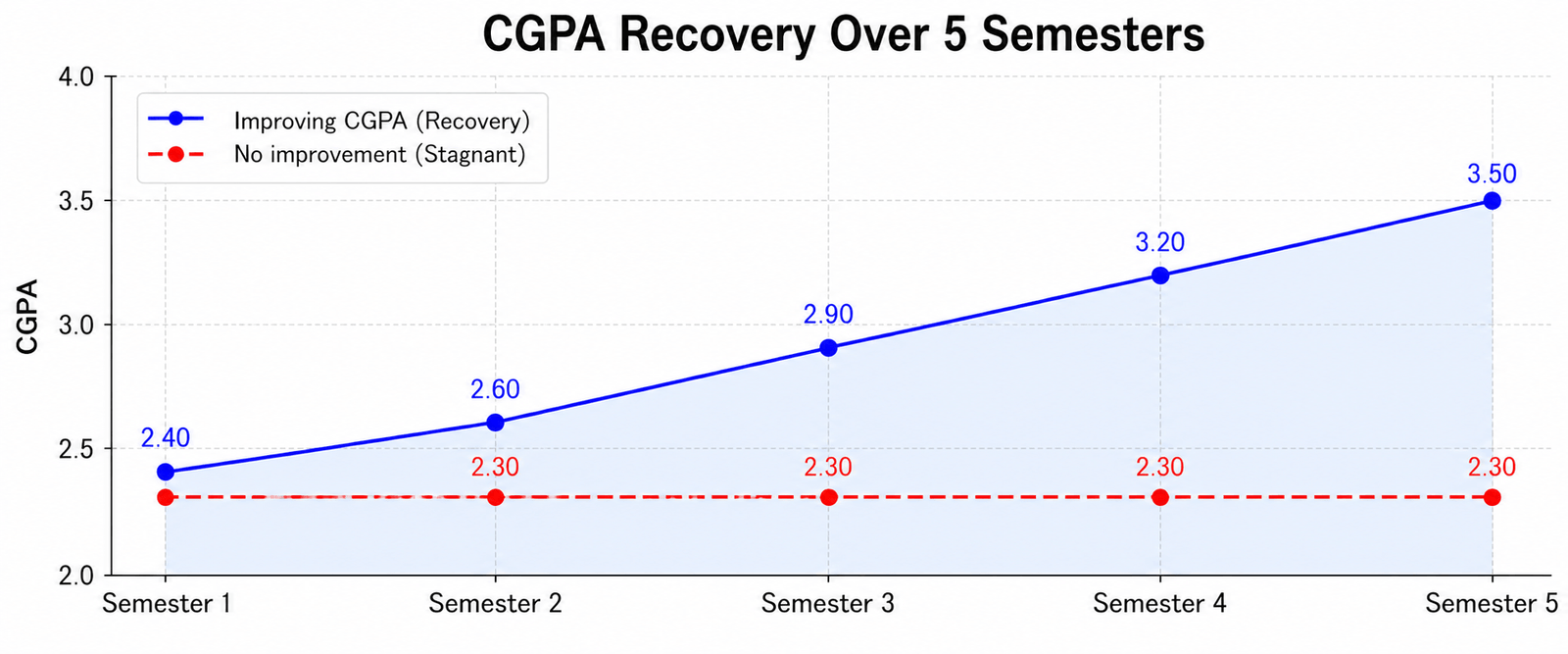
Why 3.70 — the Highest Dean's List Threshold in Pakistan
NUST's Dean's List requires a minimum semester GPA of 3.70 — higher than virtually every other Pakistani university. COMSATS and FAST require 3.50. UET requires 3.50. Punjab University is similar. NUST's 3.70 threshold reflects the university's identity as Pakistan's most demanding academic institution and ensures that the Dean's List distinction genuinely signifies exceptional performance.
To put 3.70 in perspective on NUST's scale: achieving 3.70 means your weighted average across all courses must exceed 3.70. Since NUST's grades are A (4.00), B+ (3.50), B (3.00), C+ (2.50), C (2.00), D (1.00), and F (0.00), a GPA of 3.70 requires a mix heavily weighted toward A grades with limited B+ and essentially no B or lower grades.
What Combination of Grades Achieves 3.70+ at NUST?
| Grade Mix (all 3-CH courses, 15 CH total) | Total QP | Semester GPA | Dean's List? |
|---|---|---|---|
| 5 × A (4.00) | 60.00 | 4.00 | ✅ Yes |
| 4 × A + 1 × B+ (3.50) | 58.50 | 3.90 | ✅ Yes |
| 3 × A + 2 × B+ (3.50) | 57.00 | 3.80 | ✅ Yes |
| 2 × A + 3 × B+ (3.50) | 55.50 | 3.70 | ✅ Exact threshold |
| 1 × A + 4 × B+ (3.50) | 54.00 | 3.60 | ❌ Below threshold |
| 2 × A + 2 × B+ + 1 × B (3.00) | 52.50 | 3.50 | ❌ Below threshold |
| Any course with C+ or below | Variable | <3.50 | ❌ Almost certainly no |
The table reveals the core truth of NUST Dean's List: you need at least 2 courses graded A (85%+) and 3 courses graded B+ (75%+) in a 5-course, 15-credit semester to exactly hit 3.70. Any grade below B+ in any course makes Dean's List virtually impossible without compensating A grades in other courses. In NUST's demanding academic environment, maintaining 75%+ in every course simultaneously requires consistent, semester-long effort — not just pre-exam cramming.
Additional Dean's List Requirements
- Full-time enrollment: Must be registered for the standard full credit hour load for your program year (typically 15–18 CHs)
- No F grade: Zero failing grades in any registered course that semester
- No I (Incomplete) grade: All final grades must be submitted and finalized
- No active disciplinary case: Any pending academic misconduct proceeding disqualifies you regardless of GPA
- Not on academic probation: Students on probation cannot be on the Dean's List simultaneously
The Dean's List is announced at the end of each fall and spring semester. Summer semester performance does not contribute to Dean's List consideration at most NUST schools. Students who qualify receive a certificate from their School's Dean and a permanent "Dean's Honor Roll — [Semester Year]" notation on their official transcript.
Part 5: NUST Graduation Honors and Gold Medal
| Cumulative CGPA | Latin Designation | Award | Approximate Frequency |
|---|---|---|---|
| 3.90 – 4.00 | Summa Cum Laude | Gold Medal from Rector NUST | 1–3 students per program per year |
| 3.70 – 3.89 | Magna Cum Laude | Silver Medal at Convocation | 5–15 students per program |
| 3.50 – 3.69 | Cum Laude / Distinction | Distinction noted on degree certificate | 10–25 students per program |
| 3.00 – 3.49 | High Performance | Commencement recognition | 25–40% of graduates |
| 2.00 – 2.99 | — | Standard degree | Majority of graduates |
The Gold Medal at NUST is awarded per program — the top student in Computer Science, the top student in Electrical Engineering, the top student in Mechanical Engineering each receive a Gold Medal. This makes the Gold Medal somewhat more accessible than a single university-wide award, but earning it still requires maintaining a 3.90+ CGPA across 8 semesters of NUST's demanding program — an extraordinary achievement.
Part 6: Academic Probation and Dismissal at NUST
When Probation is Triggered
Academic probation at NUST is triggered automatically when a student's cumulative CGPA falls below 2.00 at the end of any semester. The NUST student information system flags the student's record, and the school's academic office sends a formal probation notice within the first week of the following semester. Probation is a serious academic status — it is noted in the student's file and affects multiple aspects of their university life.
Immediate Consequences of Probation
- Mandatory enrollment in the school's academic advising program with scheduled weekly or bi-weekly meetings
- Course registration cap — typically limited to 12–15 credit hours per semester (versus the standard 18 CH maximum)
- All NUST merit scholarships and financial assistance suspended immediately
- Cannot hold leadership positions in NUST student societies, clubs, or organizations
- May be restricted from representing NUST in inter-university competitions
- Cannot be nominated for any awards, recognitions, or Dean's List regardless of semester GPA during probation
Recovery Timeline and Requirements
Students on academic probation at NUST are typically given two consecutive semesters to raise their cumulative CGPA above 2.00. The expectation during probation is not just that the CGPA eventually crosses 2.00, but that the student demonstrates consistent upward momentum — ideally maintaining a semester GPA of 2.50 or above during each probation semester.
If after two semesters on probation the cumulative CGPA has not recovered above 2.00, the student's case is referred to the school's Academic Review Committee. Possible outcomes include: extension of the probation period (rare, requires exceptional circumstances), academic dismissal with appeal rights, or requirement to change to a less demanding program.
Academic Dismissal Appeal Process
Students facing academic dismissal at NUST have the right to appeal to the school's Academic Appeal Committee. A successful appeal requires documented evidence of serious extenuating circumstances — severe illness (supported by detailed medical reports and hospitalization records), death of immediate family member during the study period, or other extraordinary circumstances beyond the student's control. Academic difficulty alone, without such circumstances, generally does not constitute grounds for a successful appeal.
Part 7: Course Repeat Policy at NUST
Failed Course Retakes
NUST requires students to retake failed courses (F grade). The retake must typically be taken as soon as the course is next offered — you cannot defer retaking a failed course indefinitely. Failed core requirement courses must be cleared before advancing to dependent courses in the program sequence.
Grade Improvement Policy
NUST's policy on grade replacement varies by school. At most constituent schools, the new grade from a retake replaces the original F (or D) grade in the CGPA quality points calculation. The original grade remains visible on the transcript with an "R" (Repeated) notation, but only the new grade contributes to the cumulative GPA. Some NUST schools allow retaking passed courses for grade improvement under specific conditions — verify the current policy with your school's academic office.
Strategic Retaking
When considering which courses to retake for grade improvement, prioritize based on:
- Credit hours (highest first): Retaking a 4-credit course (Engineering Mathematics, Calculus) has 4× the CGPA impact of a 1-credit lab
- Current grade (lowest first): Replacing an F (0.00 GP) has more impact than replacing a D (1.00 GP), which has more impact than replacing a C (2.00 GP)
- Realistic improvement potential: Only retake a course where you have genuinely improved your understanding of the material — retaking without substantive preparation typically yields marginal improvement
Part 8: NUST vs Other Universities — Comparative Analysis
One question that comes up frequently in Pakistani academic discussions: how does NUST's CGPA compare to CGPA from other universities? The answer has two dimensions — scale differences and difficulty differences.
Scale Differences — How Same Marks Give Different GPAs
| Marks % | NUST GP | COMSATS GP | UET GP | Difference (NUST vs COMSATS) |
|---|---|---|---|---|
| 88% | A = 4.00 | A = 4.00 | A = 4.00 | Equal |
| 82% | B+ = 3.50 | A- = 3.67 | A = 4.00 | NUST lower by 0.17 |
| 77% | B+ = 3.50 | B+ = 3.33 | B = 3.00 | NUST higher by 0.17 |
| 72% | B = 3.00 | B = 3.00 | B = 3.00 | Equal |
| 68% | C+ = 2.50 | B- = 2.67 | C = 2.00 | NUST lower by 0.17 |
| 65% | C+ = 2.50 | C+ = 2.33 | C = 2.00 | NUST higher by 0.17 |
| 55% | D = 1.00 | D+ = 1.33 | D = 1.00 | NUST lower by 0.33 |
The pattern is nuanced: NUST's scale is more generous than COMSATS at the 75–84% range (B+ = 3.50 vs 3.33), equal at the 71–74% range, more generous than COMSATS at the 65–67% range (C+ = 2.50 vs 2.33), but less generous at the 80–84% range (B+ = 3.50 vs A- = 3.67). UET is the most generous at the top (80%+ earns 4.00) but equal to NUST at lower ranges.
Difficulty Differences — Why Context Matters
Beyond scale differences, NUST's programs are generally considered more academically rigorous than most comparable Pakistani university programs. This means a 3.00 CGPA at NUST may represent stronger underlying academic ability than a 3.20 CGPA at a less demanding institution — a distinction that graduate school admissions committees at NUST, LUMS, and international universities are aware of when evaluating applications.
Part 9: NUST CGPA to Percentage Conversion
NUST Examples:
3.90 CGPA → 97.5% (Gold Medal territory)
3.70 CGPA → 92.5% (Dean's List / Silver Medal)
3.50 CGPA → 87.5% (First Division with Merit)
3.00 CGPA → 75.0% (First Division)
2.50 CGPA → 62.5% (Second Division)
2.00 CGPA → 50.0% (Pass — minimum graduation)
For official purposes — CSS applications, FPSC, PPSC, overseas scholarship applications — always request a formal percentage equivalence certificate from NUST's Registrar Office rather than self-calculating. The Registrar's certificate with NUST's official stamp is the most authoritative document for formal submissions. For quick estimates, use our free CGPA to Percentage Converter.
Part 10: Proven Strategies for NUST CGPA Improvement

🎯 Strategy 1: Calculate Mark Targets Before Every Exam
Before each midterm and final, calculate exactly what marks you need to cross the next grade boundary in each course. If your current standing is 68% total with 40% remaining, you need 82.5% on the final to reach 75% (B+ territory). Making this calculation concrete replaces vague anxiety with a specific target to work toward.
📊 Strategy 2: Use the Correct NUST Calculator
Always use our NUST GPA Calculator (select "NUST" from dropdown) which uses NUST's 7-grade scale. Knowing your exact current GPA and what it would become under various improvement scenarios helps you set realistic priorities among your courses.
📅 Strategy 3: Use Office Hours in Weeks 2–5, Not 12–16
NUST faculty hold regular office hours — many SEECS, SMME, and SCME faculty are genuinely accessible and appreciate proactive students. Visiting in the first half of the semester (not pre-exam panic) builds understanding, rapport, and sometimes more generous grading on borderline work.
🏆 Strategy 4: Exploit Lab Courses for GPA
1-credit lab courses at NUST are often easier to score A (4.00 GP) in than 3-credit lecture courses. Six lab courses at A contribute 24 quality points — equivalent to the A contribution of a 6-credit FYP. Invest in lab performance; it's high-return relative to time.
🔁 Strategy 5: Summer Semester Retakes
NUST's summer semester allows up to 9 credit hours and is ideal for retaking D or F courses. Smaller summer classes often mean more individual faculty attention. A D→A improvement on a 3-credit course adds 9 quality points to your cumulative total — substantial CGPA impact.
📈 Strategy 6: Model Your Recovery Mathematically
Use our CGPA Improvement Calculator to model your exact path to target CGPA. Enter current CGPA, completed credit hours, target CGPA, and planned future semester GPA. The tool tells you precisely how many more semesters at your planned GPA level will reach your target. No guesswork.
Part 11: NUST FYP and Its CGPA Impact
The Final Year Project (FYP) at NUST is the most heavily weighted single academic activity available to students, typically spanning two semesters at 3 credit hours each (6 total). The FYP's quality points contribution:
| FYP Grade | Grade Points | Total QP (6 CH) | CGPA Impact (on 130 CH degree) |
|---|---|---|---|
| A (excellent project) | 4.00 | 24.00 | Maximum contribution to final CGPA |
| B+ (good project) | 3.50 | 21.00 | 3 fewer QPs than A — about 0.02 CGPA difference |
| B (satisfactory) | 3.00 | 18.00 | 6 fewer QPs than A — about 0.05 CGPA difference |
| C+ (minimum acceptable) | 2.50 | 15.00 | 9 fewer QPs than A — about 0.07 CGPA difference |
Investing in FYP quality pays CGPA dividends. Choose a topic you're genuinely interested in, select a supervisor whose research aligns with yours, start work in Semester 7 before FYP officially registers, and aim for a project that can produce a conference paper. An FYP that generates a publication dramatically strengthens your graduate school and job applications independently of its CGPA contribution.
Part 12: NUST MS and PhD Admissions — CGPA Requirements
| Program | Minimum CGPA | Competitive CGPA | Additional Requirements |
|---|---|---|---|
| MS at NUST (all schools) | 2.50 | 3.00+ | GAT General 50+; interview |
| PhD at NUST | 3.00 (from MS) | 3.50+ | GAT Subject 60+; publications preferred |
| HEC Overseas MS/PhD | 3.00 | 3.50+ | IELTS 6.5+; GAT 60+ |
| Fulbright Pakistan | 3.00 | 3.50+ | IELTS/TOEFL; 2+ years experience |
| US PhD Programs (research) | 3.00 | 3.30+ | GRE Quant 158+; strong SOP; research |
| UK Master's (competitive) | 3.00 (2:1 equivalent) | 3.30+ | IELTS 6.5+; personal statement |
Frequently Asked Questions About NUST's Grading System
Is a 3.0 CGPA good at NUST?
A 3.0 CGPA at NUST represents First Division performance and is considered good. It qualifies you for most graduate programs and professional employers. Given NUST's rigorous academic environment, even a 2.8–3.0 CGPA reflects genuine academic effort. For competitive scholarships and elite programs, 3.3+ is preferred.
Why does NUST use a 7-grade system instead of the HEC 12-grade standard?
NUST adopted its 7-grade system before HEC's widespread standardization push and maintained it as a distinctive institutional approach. The simpler scale has larger jumps between grade boundaries, which NUST argues provides clearer differentiation between performance levels. The scale has remained consistent for decades and is well-understood by Pakistani employers and international universities.
Does NUST's grading scale disadvantage students when applying abroad?
International graduate programs and credential evaluators (WES, ECE) are familiar with NUST's scale and evaluate transcripts in context. A NUST CGPA of 3.0 on a 4.0 scale is generally equivalent to a US GPA of 3.0 and a UK Upper Second Class (2:1). The institutional reputation of NUST often compensates for scale-based numerical differences — a 3.0 from NUST carries more weight than a 3.3 from an unknown institution with a more generous scale.
How does NUST summer semester work for CGPA recovery?
NUST's summer semester (typically June–August) allows students to enroll in a maximum of 9 credit hours. Summer is particularly effective for retaking failed or D-grade courses because: class sizes are smaller, instruction tends to be more focused, and concentrating on fewer courses at once improves performance prospects. Summer grades are included in cumulative CGPA calculations and appear on the transcript alongside regular semester results.
Use our free NUST GPA Calculator — select "NUST" from the dropdown to automatically apply NUST's 7-grade scale. Use the Dean's List Checker to see if your semester GPA qualifies for NUST's 3.70 threshold. Questions? Email contact@techpot.site