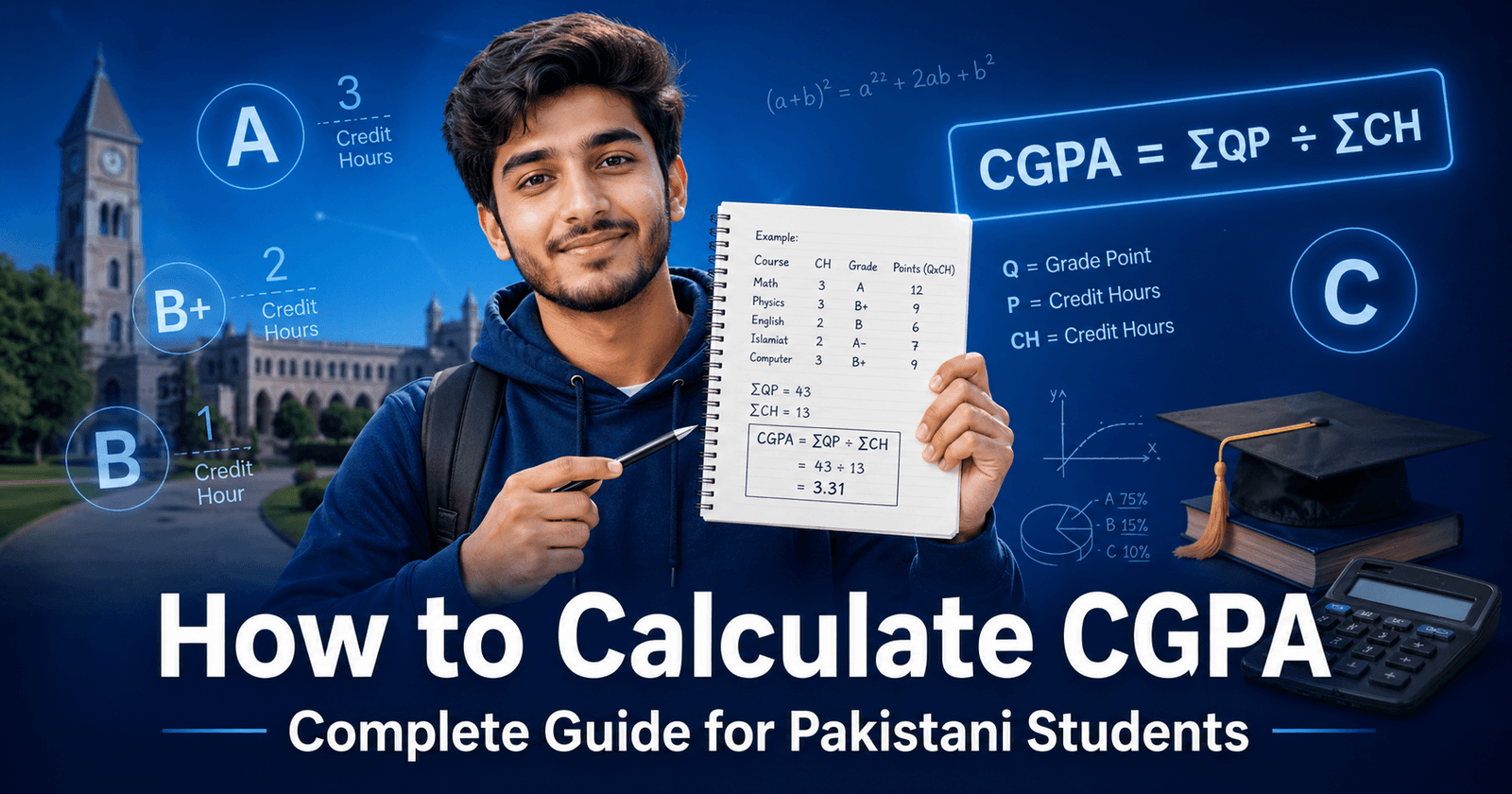
If you are studying at a Pakistani university, your CGPA is the single most important number in your academic life. It decides whether you make the Dean's List, whether you qualify for scholarships, whether you get called for job interviews, whether you can apply for MS programs, and how your government job merit is calculated. Yet a large percentage of Pakistani students — including those in their third and fourth year — cannot accurately calculate their own CGPA.
This is not because CGPA calculation is difficult. It is because most students never had it properly explained to them. Their university orientation was rushed, the student handbook uses technical language, and online resources either use the wrong grading scale or provide generic advice that does not apply to the Pakistani context.
This guide fixes all of that. By the time you finish reading, you will know exactly how CGPA works at any Pakistani university, how to calculate it manually with complete accuracy, how to use our free calculator tools for instant results, and how to plan your academic performance strategically to achieve the CGPA you want. Let us begin.
Part 1: Understanding the Fundamentals
What CGPA Stands For and What It Means
CGPA stands for Cumulative Grade Point Average. Each word matters:
- Cumulative means it accumulates — it is a running total that includes every course from your first semester to your most recent completed semester. A poor first semester remains in your CGPA even in your final year, though its relative impact decreases as you complete more credit hours.
- Grade Point is a numerical value assigned to each letter grade according to your university's specific grading scale. At most Pakistani universities, the scale runs from 0.00 (F grade) to 4.00 (A+ or A grade).
- Average — critically — is a weighted average, not a simple average. Each course's contribution to your CGPA is proportional to the number of credit hours it carries. A 4-credit hour course has exactly twice the impact of a 2-credit hour course on your CGPA.
The alternative term you'll hear at Pakistani universities is GPA (Grade Point Average) — typically referring to a single semester's performance rather than the cumulative total. Your transcript shows both: a semester GPA for each term and a running cumulative CGPA that updates after each semester.
Why the Pakistani CGPA System Is on a 4.0 Scale
Pakistan's Higher Education Commission (HEC) adopted the 4.0 GPA scale in the early 2000s as part of the effort to align Pakistani higher education with international standards, particularly the American university system. Before HEC's standardization push, Pakistani universities used widely varying systems — some used percentage marks only, others used descriptive grades like "Distinction, Merit, Pass," and minimum pass marks ranged from 33% to 50% across institutions.
The 4.0 scale brings several benefits: it allows easy international comparison of Pakistani degrees, it enables more granular performance tracking than broad percentage divisions, it makes grade-based scholarship and honor calculations more transparent, and it aligns Pakistani transcripts with the expectations of foreign graduate programs and international employers.
Today, virtually every HEC-recognized Pakistani university uses a 4.0 CGPA scale. However — and this is crucial — different universities map letter grades to grade points differently, which means the same percentage marks can produce different GPAs at different institutions. We will cover university-specific differences in detail later in this guide.
Part 2: The Complete CGPA Calculation Formula
The Core Formula
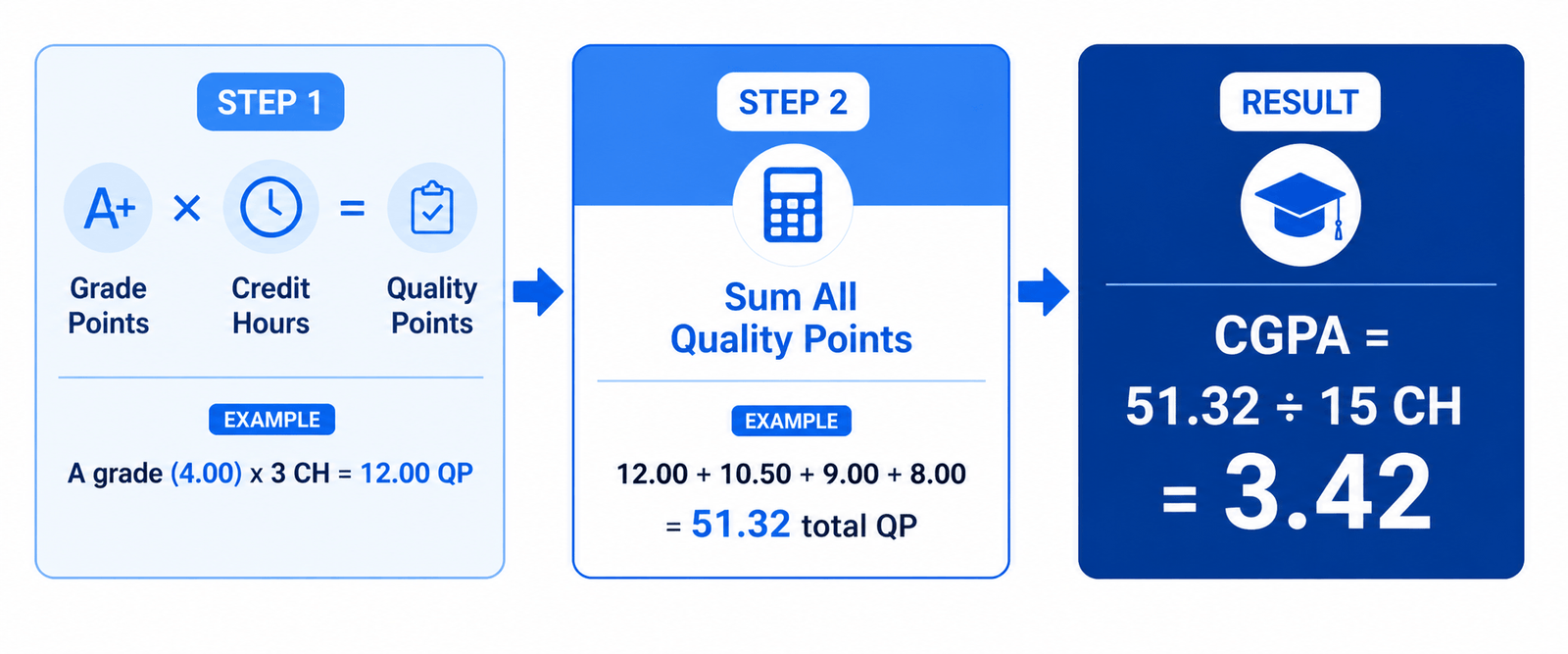
The CGPA formula used at all Pakistani universities is identical in structure, though the grade point values differ by institution:
Or equivalently written:
CGPA = Total Quality Points ÷ Total Credit Hours
Where: Quality Points for each course = Grade Points × Credit Hours for that course
This is a weighted average formula. The "weight" of each course is its credit hour value. A 3-credit course contributes 3 times as many quality points (at the same grade) as a 1-credit lab course. This weighting is intentional and reflects the greater time investment and academic significance of higher-credit courses.
Step-by-Step Calculation Process
For each course you are enrolled in, note: the course name (for reference), the credit hours, and your marks percentage or final letter grade. You can find this on your semester result slip, your university student portal (REMS at COMSATS, SAP at NUST, ICMS at FAST, LMS at VU), or your official transcript. Do not use estimated marks — use only finalized, official grades.
This is where students make the most critical errors. Different universities use different grade-to-point mappings. NUST uses a 7-grade system (A=4.00, B+=3.50, B=3.00, C+=2.50, C=2.00, D=1.00, F=0.00). COMSATS, FAST, and most other HEC universities use a 12-grade system (A+=4.00, A=4.00, A-=3.67, B+=3.33, B=3.00, B-=2.67, C+=2.33, C=2.00, C-=1.67, D+=1.33, D=1.00, F=0.00). UET uses a 6-grade system (A+=4.00, A=4.00, B=3.00, C=2.00, D=1.00, F=0.00). Using the wrong scale for your university will give you incorrect results. Our GPA Calculator selects the correct scale automatically when you choose your university.
For each course: Quality Points = Grade Points × Credit Hours
Example: A- grade (3.67 GP) in a 3-credit course = 3.67 × 3 = 11.01 quality points
Example: B+ grade (3.33 GP) in a 2-credit course = 3.33 × 2 = 6.66 quality points
Example: A grade (4.00 GP) in a 1-credit lab = 4.00 × 1 = 4.00 quality points
Add together the quality points from every course in the period you are calculating (one semester for GPA, all semesters for CGPA). Keep this as a running total if calculating CGPA: Total QP = QP from Sem 1 + QP from Sem 2 + QP from Sem 3 + ...
Add together the credit hours from every course in the same period. For cumulative CGPA, this is all credit hours ever completed: Total CH = CH from Sem 1 + CH from Sem 2 + CH from Sem 3 + ...
CGPA = Total Quality Points ÷ Total Credit Hours
Round to 2 decimal places. Do not round intermediate values — carry full decimal precision through all calculations and only round the final CGPA result.
Part 3: The HEC Standard Grading Scale
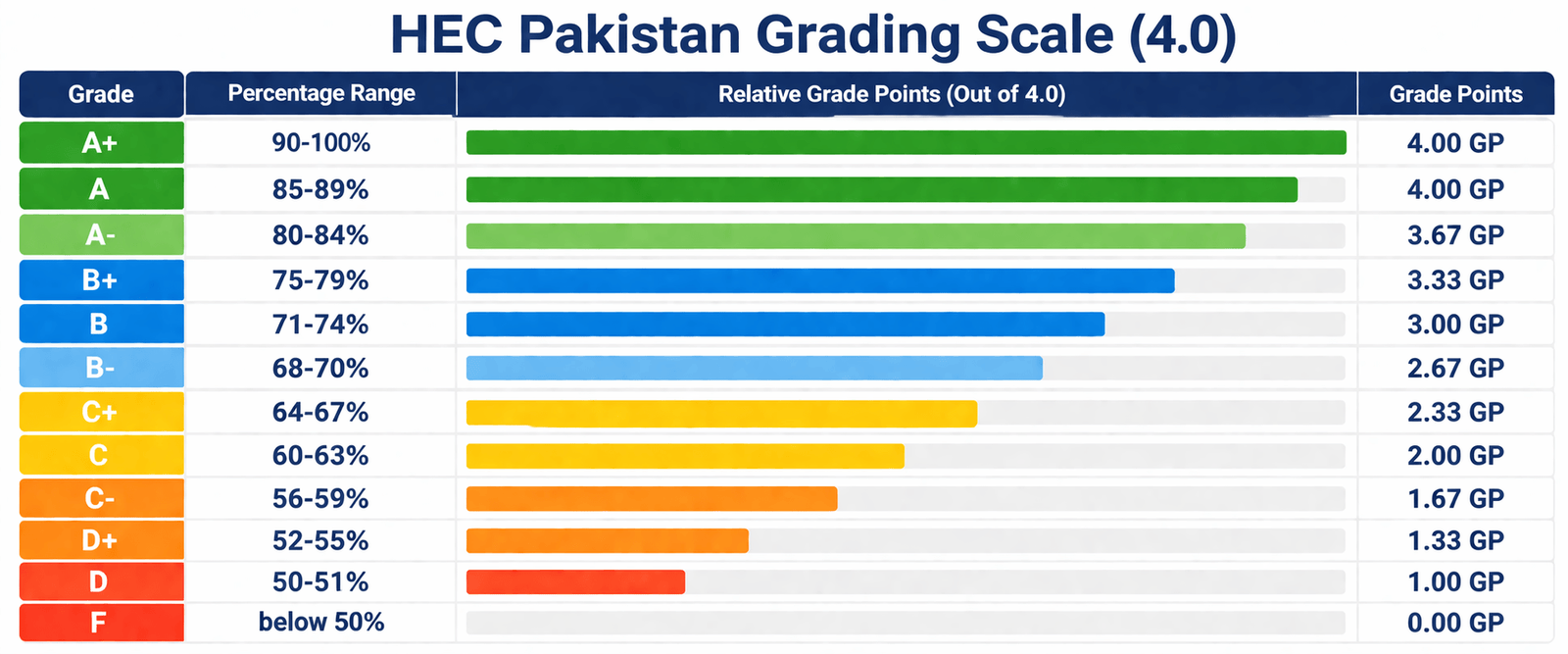
The Higher Education Commission of Pakistan recommends the following 12-grade system. This is the scale used at COMSATS University, FAST-NUCES, IBA Karachi, UCP, Air University, and most other HEC-accredited institutions:
| Marks % | Letter Grade | Grade Points | Academic Standing | QP per 3-CH Course |
|---|---|---|---|---|
| 90 – 100 | A+ | 4.00 | Outstanding | 12.00 |
| 85 – 89 | A | 4.00 | Excellent | 12.00 |
| 80 – 84 | A- | 3.67 | Very Good | 11.01 |
| 75 – 79 | B+ | 3.33 | Good | 9.99 |
| 71 – 74 | B | 3.00 | Above Average | 9.00 |
| 68 – 70 | B- | 2.67 | Average | 8.01 |
| 64 – 67 | C+ | 2.33 | Below Average | 6.99 |
| 60 – 63 | C | 2.00 | Satisfactory | 6.00 |
| 56 – 59 | C- | 1.67 | Low Pass | 5.01 |
| 52 – 55 | D+ | 1.33 | Very Low Pass | 3.99 |
| 50 – 51 | D | 1.00 | Minimum Pass | 3.00 |
| Below 50 | F | 0.00 | Fail | 0.00 |
Critical Point: A+ and A Are Worth the Same
Notice that A+ (90–100%) and A (85–89%) both earn 4.00 grade points. This means that scoring 95% in a course produces exactly the same grade point value as scoring 85%. This is an extremely important insight for time management: if you are already at 86% in a course, spending extra study hours trying to push it to 92% yields zero additional grade points. That same time would be far better invested in courses where you can push marks above the next grade boundary (e.g., from 74% to 75% to earn B+ instead of B, adding 0.33 GP per credit hour).
Part 4: Complete Worked Examples
Example 1: COMSATS Semester 2 — Computer Science
Let's calculate a complete semester GPA for a Computer Science student at COMSATS Islamabad using the HEC standard 12-grade scale:
| Course | Credit Hrs | Marks % | Letter Grade | Grade Points | Quality Points |
|---|---|---|---|---|---|
| Calculus II | 3 | 82 | A- | 3.67 | 11.01 |
| Object-Oriented Programming | 3 | 76 | B+ | 3.33 | 9.99 |
| Applied Physics | 3 | 91 | A+ | 4.00 | 12.00 |
| Digital Logic Design | 3 | 65 | C+ | 2.33 | 6.99 |
| English Composition II | 2 | 87 | A | 4.00 | 8.00 |
| OOP Lab | 1 | 79 | B+ | 3.33 | 3.33 |
| Pakistan Studies | 2 | 93 | A+ | 4.00 | 8.00 |
| TOTALS | 17 | — | — | — | 59.32 |
Semester GPA = 59.32 ÷ 17 = 3.49
Analysis: This student earned a strong 3.49 GPA — just one-hundredth of a point below COMSATS's 3.50 Dean's List threshold! The Digital Logic Design course (C+, 2.33 GP) is the weakest link, contributing only 6.99 quality points out of a possible 12.00 for a 3-credit course. If this student had scored 68% instead of 65% in Digital Logic Design, they would have earned B- (2.67 GP) instead of C+ (2.33 GP), adding 1.02 quality points to the total. That change alone would push the semester GPA to 3.55 — Dean's List qualifying.
This example illustrates a critical lesson: a single mark improvement at the right grade boundary can make the difference between qualifying for significant academic recognition or missing it.
Example 2: NUST Semester 4 — Electrical Engineering
Now let's calculate for a NUST student using NUST's 7-grade scale (very different from HEC standard):
| Course | Credit Hrs | Marks % | NUST Grade | Grade Points | Quality Points |
|---|---|---|---|---|---|
| Signals and Systems | 3 | 87 | A | 4.00 | 12.00 |
| Digital Electronics | 3 | 79 | B+ | 3.50 | 10.50 |
| Engineering Mathematics III | 3 | 72 | B | 3.00 | 9.00 |
| Communication Skills | 2 | 90 | A | 4.00 | 8.00 |
| Probability & Statistics | 3 | 67 | C+ | 2.50 | 7.50 |
| Digital Electronics Lab | 1 | 86 | A | 4.00 | 4.00 |
| Pakistan Studies | 2 | 88 | A | 4.00 | 8.00 |
| TOTALS | 17 | — | — | — | 59.00 |
Semester GPA = 59.00 ÷ 17 = 3.47
Key difference from COMSATS example: Notice that at NUST, B+ = 3.50 GP (not 3.33 as at COMSATS). A student scoring 79% at NUST earns 3.50 GP, while the same 79% at COMSATS earns only 3.33 GP (B+). This is why using the correct university-specific scale is non-negotiable for accurate GPA calculations.
Also note: at NUST, the Probability & Statistics course (67%) earns C+ = 2.50 GP, whereas at COMSATS the same 67% also earns C+ but = 2.33 GP. NUST's C+ is 0.17 GP higher than COMSATS's C+ at the same percentage.
Example 3: UET Lahore Semester 2 — Civil Engineering
| Course | Credit Hrs | Marks % | UET Grade | Grade Points | Quality Points |
|---|---|---|---|---|---|
| Engineering Mathematics II | 4 | 83 | A | 4.00 | 16.00 |
| Structural Analysis I | 3 | 74 | B | 3.00 | 9.00 |
| Fluid Mechanics | 3 | 88 | A | 4.00 | 12.00 |
| Engineering Drawing | 2 | 66 | C | 2.00 | 4.00 |
| Technical Communication | 2 | 91 | A+ | 4.00 | 8.00 |
| Physics Lab | 1 | 77 | B | 3.00 | 3.00 |
| TOTALS | 15 | — | — | — | 52.00 |
Semester GPA = 52.00 ÷ 15 = 3.47
Critical UET Insight: At UET, the grade bands are very wide — B covers the entire 70–79% range at 3.00 GP, and A covers both 80–89% (A) and 90–100% (A+) at 4.00 GP. The student scoring 83% and the student scoring 89% in the same UET course both earn exactly A (4.00 GP). The jump between B (3.00) and A (4.00) at UET's 80% threshold is a massive 1.00 GP per credit hour — the most impactful single grade boundary in Pakistani university systems. On a 4-credit Mathematics course, crossing from 79% to 80% adds 4.00 extra quality points.
Part 5: Calculating Cumulative CGPA Across Multiple Semesters
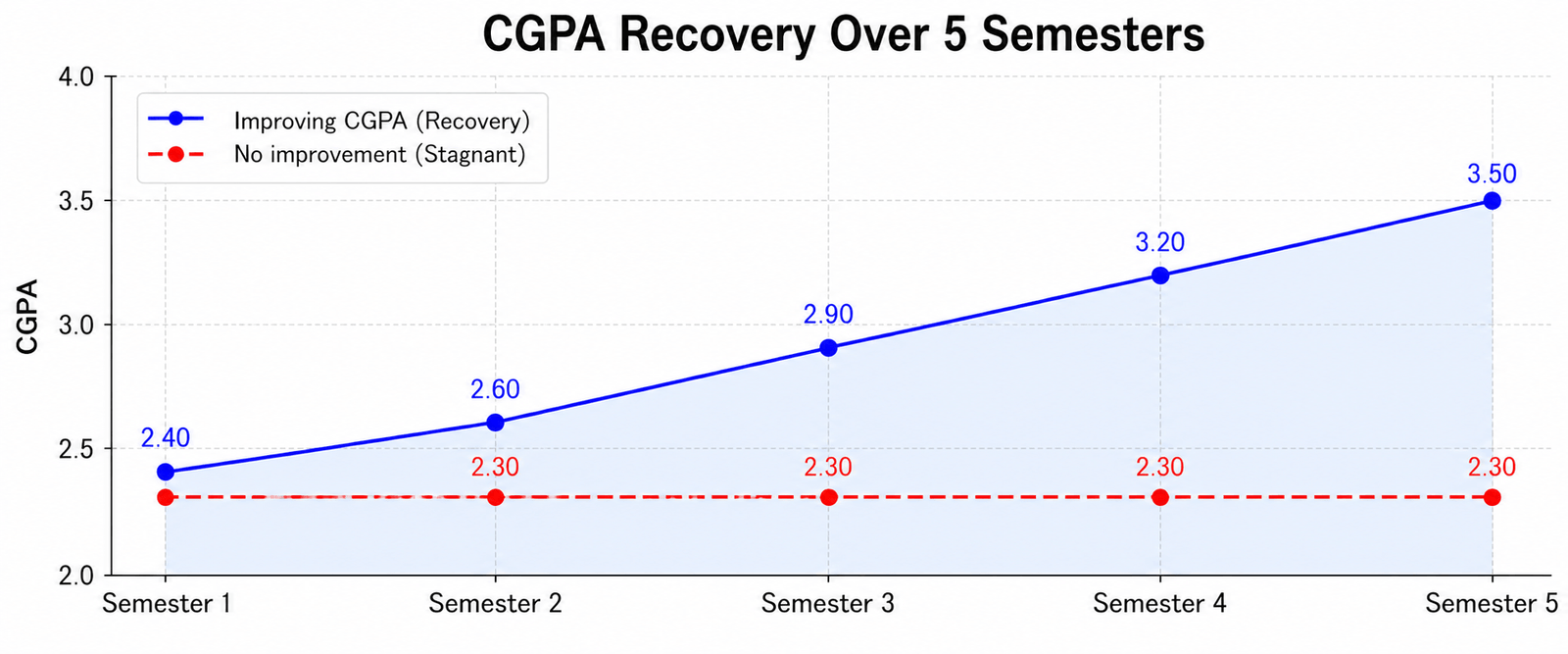
This is where most students make their most significant calculation mistake. Cumulative CGPA is NOT calculated by averaging your semester GPAs. It is always calculated by combining all quality points and all credit hours from every semester together.
CGPA = (Sem 1 GPA + Sem 2 GPA + Sem 3 GPA) ÷ 3
This gives incorrect results whenever semesters have different credit hours — which is almost always the case.
✅ CORRECT Method:
CGPA = (All Quality Points from ALL Semesters) ÷ (All Credit Hours from ALL Semesters)
Complete Multi-Semester CGPA Example
| Semester | Credit Hours | Quality Points | Semester GPA | Running Cumulative CGPA |
|---|---|---|---|---|
| Semester 1 | 17 | 54.40 | 3.20 | 54.40 ÷ 17 = 3.20 |
| Semester 2 | 17 | 59.32 | 3.49 | (54.40+59.32) ÷ (17+17) = 113.72 ÷ 34 = 3.34 |
| Semester 3 | 18 | 66.60 | 3.70 | 180.32 ÷ 52 = 3.47 |
| Semester 4 | 18 | 68.40 | 3.80 | 248.72 ÷ 70 = 3.55 |
| Semester 5 | 18 | 66.60 | 3.70 | 315.32 ÷ 88 = 3.58 |
| Semester 6 | 18 | 68.40 | 3.80 | 383.72 ÷ 106 = 3.62 |
| Semester 7 | 18 | 70.20 | 3.90 | 453.92 ÷ 124 = 3.66 |
| Semester 8 | 18 | 72.00 | 4.00 | 525.92 ÷ 142 = 3.70 |
This table shows a student who started with a modest 3.20 GPA in Semester 1 and gradually improved to a perfect 4.00 in their final semester. Notice how the cumulative CGPA moves slowly — even a perfect 4.00 semester at the end of the degree only moves the cumulative from 3.66 to 3.70. This is the "CGPA inertia" effect: the more semesters you have completed, the harder it is to move your cumulative CGPA significantly in either direction. This makes early-semester performance disproportionately important.
Why the Simple Average Method Gives Wrong Results
Let's prove this with a concrete example. Suppose a student has two semesters:
- Semester 1: GPA 2.80, 12 credit hours (light semester)
- Semester 2: GPA 3.60, 21 credit hours (heavy semester)
Simple average (WRONG): (2.80 + 3.60) ÷ 2 = 3.20
Correct weighted average:
- Semester 1 Quality Points: 2.80 × 12 = 33.60
- Semester 2 Quality Points: 3.60 × 21 = 75.60
- Total QP: 33.60 + 75.60 = 109.20
- Total CH: 12 + 21 = 33
- CGPA = 109.20 ÷ 33 = 3.31
The simple average gives 3.20 but the correct answer is 3.31 — a full 0.11 CGPA points higher. The difference arises because Semester 2 (with the higher GPA) had more credit hours, so it deserves proportionally more weight. The weighted average correctly accounts for this.
Part 6: University-Specific Grading Scales — Critical Differences
This section could save you significant calculation errors. Here is a direct comparison of how the same percentage marks translate to different grade points at different Pakistani universities:
| Marks % | NUST Grade / GP | COMSATS/FAST Grade / GP | UET Grade / GP | Punjab University Grade / GP |
|---|---|---|---|---|
| 95% | A / 4.00 | A+ / 4.00 | A+ / 4.00 | A+ / 4.00 |
| 87% | A / 4.00 | A / 4.00 | A / 4.00 | A / 4.00 |
| 82% | B+ / 3.50 | A- / 3.67 | A / 4.00 | A / 4.00 |
| 77% | B+ / 3.50 | B+ / 3.33 | B / 3.00 | B+ / 3.50 |
| 72% | B / 3.00 | B / 3.00 | B / 3.00 | B / 3.00 |
| 69% | C+ / 2.50 | B- / 2.67 | C / 2.00 | C+ / 2.50 |
| 65% | C+ / 2.50 | C+ / 2.33 | C / 2.00 | C+ / 2.50 |
| 61% | C / 2.00 | C / 2.00 | C / 2.00 | C / 2.00 |
| 55% | D / 1.00 | D+ / 1.33 | D / 1.00 | D+ / 1.50 |
| 51% | D / 1.00 | D / 1.00 | D / 1.00 | D / 1.00 |
The most striking differences in this table:
- At 82%: UET gives 4.00 GP (A), COMSATS gives 3.67 GP (A-), NUST gives 3.50 GP (B+). UET's 82% is worth 0.50 GP more per credit hour than NUST's. On a 3-credit course, that's 1.50 extra quality points.
- At 69%: COMSATS gives 2.67 GP (B-), while UET gives only 2.00 GP (C). COMSATS is significantly more generous in this marks range.
- At 55%: COMSATS gives D+ (1.33 GP), while NUST and UET give only D (1.00 GP). The same borderline pass performance earns 33% more grade points at COMSATS than at NUST or UET.
These differences mean that comparing CGPAs across universities requires caution. A 3.20 CGPA at UET may represent higher underlying performance than a 3.30 CGPA at COMSATS, because UET's scale is generally less generous in the middle ranges. Context matters when interpreting GPAs across institutions.
Part 7: What Counts in CGPA and What Doesn't
Courses Included in CGPA Calculation
- All graded courses (A through F): Every course where you received a letter grade from A+ to F is included in your CGPA calculation, whether you performed well or poorly
- Failed courses (F grade): A failed course with 0.00 GP remains in your CGPA calculation until successfully retaken. At most Pakistani universities with a grade replacement policy, the F grade is replaced in the CGPA calculation once you retake and pass the course
- Repeated courses (under grade replacement): When a university uses grade replacement, the newer (better) grade replaces the original in the quality points calculation. The original grade may still appear on the transcript with an "R" notation but is not counted in the GPA
- High credit-hour courses: Laboratory courses (1 CH), core theory courses (3 CH), and heavy courses like engineering mathematics (4 CH) all contribute proportionally to their credit hours
Courses Typically NOT Included in CGPA
- Withdrawn courses (W grade): If you officially withdraw from a course before the withdrawal deadline, the course typically does not count in your CGPA calculation. A W appears on your transcript but contributes neither quality points nor credit hours to your GPA
- Audit courses: Courses taken for learning without credit do not count in CGPA calculations
- Pass/Fail courses: Some universities offer Pass/Fail grading for certain electives or non-credit activities. These are typically excluded from CGPA calculations
- Non-credit seminars and workshops: Zero-credit activities do not enter the CGPA formula because they have no credit hours to weight
- Transfer credits: Credit hours transferred from another institution may or may not be included in your CGPA calculation depending on your university's policy. At many Pakistani universities, transfer credits are accepted toward degree requirements but the transfer grades are not included in the local CGPA calculation
- Incomplete (I) grades: A grade of I (Incomplete) is a temporary status and is not counted in the CGPA until a final grade is submitted
Part 8: Understanding Credit Hours
Credit hours are the "weights" in your weighted GPA calculation. Understanding the credit hour system helps you allocate your study time most efficiently.
How Credit Hours Are Assigned
In Pakistani universities following HEC guidelines:
- 3-credit lecture course: The most common type. Meets for 3 hours of instruction per week over 16–18 weeks. Core mathematics, CS, engineering, and management courses are typically 3 credits.
- 4-credit course: Usually reserved for foundational mathematical courses (Calculus, Linear Algebra, Differential Equations) at engineering universities. The extra credit hour reflects the additional problem-solving and tutorial time expected.
- 2-credit course: Common for language courses (English, Urdu), Islamic Studies, Pakistan Studies, and shorter theory modules.
- 1-credit lab: Laboratory components attached to lecture courses. Despite meeting for 2–3 hours per week, labs typically carry only 1 credit because lab sessions are considered complementary rather than primary instruction hours.
- 6-credit Final Year Project (FYP) or Thesis: The most heavily weighted single academic activity. Spanning two semesters (3 CH each), FYP or thesis work carries enormous CGPA impact.
How Credit Hours Affect Your CGPA
The practical implication for study strategy is straightforward: invest your effort proportionally to credit hours. A 4-credit course deserves 4 times as much study time as a 1-credit lab, because improving your grade in the 4-credit course has 4 times the CGPA impact. Many students intuitively understand this, but it's worth stating explicitly because the implications are dramatic:
| Action | Credit Hours | GP Improvement | Extra Quality Points | CGPA Impact (on 60-CH base) |
|---|---|---|---|---|
| Improve 1-CH lab: C→A | 1 | +2.00 | +2.00 | +0.033 |
| Improve 2-CH course: C→A | 2 | +2.00 | +4.00 | +0.067 |
| Improve 3-CH course: C→A | 3 | +2.00 | +6.00 | +0.100 |
| Improve 4-CH course: C→A | 4 | +2.00 | +8.00 | +0.133 |
| Improve 6-CH FYP: C→A | 6 | +2.00 | +12.00 | +0.200 |
This table shows that improving from C to A in your 6-credit FYP has 6 times the CGPA impact as the same improvement in a 1-credit lab course. Your Final Year Project is the single highest-leverage academic activity available to you for CGPA improvement.
Part 9: CGPA to Percentage Conversion
Many Pakistani employers, government agencies, and graduate programs ask for your academic records in percentage rather than CGPA. Converting is straightforward but requires using the correct formula.
The Standard Pakistani Conversion Formula
This formula maps the 4.0 CGPA scale to a 100% scale:
4.00 CGPA → 100.0%
3.50 CGPA → 87.5%
3.00 CGPA → 75.0%
2.50 CGPA → 62.5%
2.00 CGPA → 50.0%
While this ×25 formula is the most widely used in Pakistan, some institutions use alternative formulas. HEC has its own recommended conversion methodology that produces slightly different results. When in doubt — particularly for official applications — request a formal percentage equivalence certificate from your university's Registrar or Controller of Examinations. This signed, stamped document is accepted by all Pakistani government agencies and most international institutions.
Use our free CGPA to Percentage Converter for quick estimates, and our Percentage to CGPA Converter for the reverse calculation.
Division Classification from CGPA
| CGPA Range | Percentage Equivalent | Pakistani Division | Government Merit Implication |
|---|---|---|---|
| 3.75 – 4.00 | 93.75 – 100% | First Division with Distinction | Maximum academic merit points |
| 3.00 – 3.74 | 75.0 – 93.5% | First Division | High academic merit points |
| 2.00 – 2.99 | 50.0 – 74.75% | Second Division | Standard academic merit points |
| Below 2.00 | Below 50% | Pass / Fail | Minimal or no academic merit points |
Part 10: The Most Common CGPA Calculation Mistakes
❌ Mistake 1: Using the Wrong University Scale
Using the HEC standard 12-grade scale for NUST (which uses a 7-grade scale) gives systematically wrong results. At 82% marks, NUST gives B+ (3.50 GP) while HEC standard gives A- (3.67 GP) — a 0.17 GP difference per credit hour. Over 17 credit hours, that's 2.89 quality points of error in a single semester. Always select your specific university in our calculator tools to apply the correct scale.
❌ Mistake 2: Averaging Semester GPAs Instead of Total QPs ÷ Total CHs
Averaging semester GPAs gives the wrong CGPA whenever semesters have different credit hours. The error can be significant — as we showed earlier, the difference can be 0.11 CGPA points or more. Always use total quality points divided by total credit hours for cumulative CGPA.
❌ Mistake 3: Including Withdrawn Courses
Courses you officially withdrew from (W grade) should not be included in your CGPA calculation. Including them artificially lowers your calculated CGPA versus your official CGPA. Check with your university's academic records office for the definitive list of courses included in your official CGPA.
❌ Mistake 4: Rounding Intermediate Values
When calculating by hand, do not round quality points before the final step. Calculate 3.67 × 3 = 11.01 (not 11). Calculate 3.33 × 2 = 6.66 (not 7). Premature rounding accumulates errors that can shift your final CGPA by 0.01–0.03 points — enough to affect whether you qualify for Dean's List or honors thresholds.
❌ Mistake 5: Thinking A+ Gives More Than A
At virtually every Pakistani university, A+ (90%+) and A (85–89%) both give 4.00 GP. Scoring 95% earns exactly the same grade points as scoring 85%. This is one of the most consequential CGPA calculation facts students don't know. Stop spending extra time trying to push an 87% to 94% — instead, use that time on courses where you're at 74% (just below B+) or 79% (just below A-).
❌ Mistake 6: Not Accounting for Lab Credit Hours Separately
Some students calculate their GPA by combining a lecture course and its associated lab as a single unit. They are separate courses with separate grades and separate credit hours. Your OOP lecture (3 CH, B+ grade) and OOP Lab (1 CH, A+ grade) are calculated completely independently. Each contributes its own quality points based on its own grade and credit hours.
Part 11: CGPA Impact on Your Future

Scholarships and Financial Aid
Pakistan's major scholarship programs all use CGPA as a primary eligibility criterion. HEC's Need-Based Scholarship requires maintaining a minimum 2.00 CGPA each semester. HEC's Overseas Scholarship for MS/PhD programs requires a minimum 3.00 CGPA from your bachelor's degree, with competitive candidates having 3.50+. The Fulbright Pakistan scholarship requires 3.00 minimum with 3.50+ for competitive applicants. COMSATS's merit-based fee waivers start at 3.30 CGPA. Corporate scholarships from PPL, Shell, and USAID typically require 3.00+. Every scholarship rupee you earn is directly connected to the CGPA you maintain.
Graduate School Admissions
For MS and PhD admissions at Pakistani universities, CGPA is the primary academic screening criterion. NUST requires 2.50 for MS admission (competitive: 3.00+). COMSATS requires 2.00 (competitive: 2.50+). LUMS and IBA require 2.80 minimum. International graduate programs — in the US, UK, and Europe — use your Pakistani CGPA directly on their 4.0 equivalent scales, with most competitive programs expecting 3.00+ and top programs preferring 3.5+.
Government Jobs and CSS
Pakistan's civil service and government sector calculate academic merit based on degree division (First Division, Second Division). A First Division degree (CGPA 3.0+, equivalent to 60%+) earns more government merit points than a Second Division degree. For FPSC, PPSC, SPSC, KPPSC, and CSS examinations, academic merit contributes 10–20% of total merit scores — enough to be the decisive factor in competitive postings where written test scores are close.
Private Sector Jobs
Most major private sector employers in Pakistan use CGPA as an initial screening filter. HBL, UBL, Telenor, Jazz, Unilever, P&G, and hundreds of other employers list minimum CGPA requirements (commonly 2.5 or 3.0) in their job postings. Candidates below the threshold are filtered out automatically before human review. A strong CGPA doesn't guarantee a job, but a weak CGPA can prevent you from ever being considered.
Part 12: CGPA Improvement Strategies
🎯 Target Grade Boundaries Specifically
Calculate what marks you need to cross the next grade boundary in each course. If you're at 73% total with 30% remaining, you need 77% on the remaining portion to reach 75% (B+ at HEC scale). This precision targeting is far more effective than vague "study harder" intentions.
📊 Prioritize High Credit-Hour Courses
Your 4-credit Engineering Mathematics course has 4× the CGPA impact of your 1-credit lab. Allocate study time proportionally. An A in a 4-credit course contributes 16 quality points vs. 4 quality points for an A in a 1-credit lab.
📈 Calculate Your Target in Advance
Use our CGPA Improvement Calculator before each semester to determine the exact semester GPA you need to maintain to reach your target cumulative CGPA by graduation. Numbers-driven planning beats hope.
🔁 Retake Low-Grade Courses Strategically
Replacing an F (0.00 GP) with a B (3.00 GP) on a 3-credit course adds 9.00 quality points to your cumulative total. Under grade replacement policies, this is the fastest way to improve CGPA. Prioritize retaking failed courses with the highest credit hours.
☀️ Use Summer Semester
Most Pakistani universities offer summer semesters (6–9 credit hours max). Smaller classes, more focused instruction, and the ability to concentrate on 1–2 courses at a time makes summer ideal for retaking courses where you scored below expectations.
📅 Track Your CGPA After Each Semester
Use our Cumulative GPA Tracker after every semester to see your trajectory. Students who monitor their CGPA trajectory make better academic decisions than students who only check at the end of the year.
Part 13: Free Calculator Tools for Pakistani Students
Manual CGPA calculation, while now fully understood after reading this guide, is time-consuming and prone to rounding errors. Our free calculator tools eliminate all manual calculation risk:
- CGPA Calculator: Add individual subjects with credit hours and grades. Works for all Pakistani universities using HEC standard scale. Results instant, no signup.
- University GPA Calculator: Select your specific university (NUST, COMSATS, FAST, UET, UCP, IBA) to automatically apply the correct grading scale. Eliminates the most common calculation error.
- Cumulative GPA Tracker: Enter your semester GPA and credit hours for each completed semester to see your exact cumulative CGPA. Handles the weighted average calculation automatically.
- CGPA to Percentage Converter: Convert any CGPA to percentage using HEC standard formula or the simple ×25 method.
- CGPA Improvement Calculator: Input current CGPA, completed credit hours, target CGPA, and planned semester GPA to find exactly how many more semesters you need to reach your goal.
- Dean's List & Honors Checker: Check if your CGPA or semester GPA meets Dean's List and graduation honor thresholds at your specific university.
Frequently Asked Questions About CGPA Calculation in Pakistan
How often is CGPA updated at Pakistani universities?
CGPA is updated after the results of each semester are finalized and posted. Most Pakistani universities process semester results 4–8 weeks after the final examination period ends. Your updated CGPA is then visible on your university's student portal. The CGPA on your transcript reflects your standing as of the most recently completed semester.
Does my CGPA include my current (in-progress) semester?
No. Your official CGPA only includes completed semesters where grades have been fully finalized. In-progress courses and semesters are not counted in your official CGPA until final grades are submitted and approved. This means the CGPA visible on your portal may not reflect courses you are currently taking.
What is the minimum CGPA to graduate from Pakistani universities?
The minimum cumulative CGPA required for graduation at most HEC-recognized Pakistani universities is 2.00 out of 4.00. Some universities may have slightly higher minimums for specific programs — engineering programs sometimes require 2.0 in technical courses separately from overall CGPA. Students who fall below 2.00 CGPA face academic probation and must improve within a specified timeframe to avoid dismissal.
Can my CGPA go down in a semester where I perform well?
Yes, technically. If your semester GPA is lower than your current cumulative CGPA, even a "good" semester will pull your cumulative CGPA down. For example, if your cumulative CGPA is 3.60 and you earn a 3.40 semester GPA, your cumulative CGPA will drop — even though 3.40 is still a strong GPA. This is the averaging effect of the weighted formula.
How does repeating a course affect my CGPA?
Under grade replacement policies (used by most HEC-recognized universities): when you retake a course, the new grade replaces the old grade in the CGPA quality points calculation. The old (worse) grade may still appear on the transcript with an "R" notation, but only the new grade contributes to your CGPA. Verify your specific university's grade replacement policy — some universities average both grades or include both in the calculation.
Is a 3.0 CGPA good in Pakistan?
A 3.0 CGPA (75% equivalent) represents First Division performance and is considered good at most Pakistani universities. It qualifies you for most MS programs, meets the minimum for most competitive private sector employers, and earns First Division classification for government merit lists. For highly competitive opportunities (top HEC scholarships, elite employers, international graduate schools), 3.3–3.5+ is preferred.
Use our free CGPA Calculator for HEC-standard scale, or our University GPA Calculator to select your specific university (NUST, COMSATS, FAST, UET) and get instant, accurate results. No signup required. Questions? Email us at contact@techpot.site