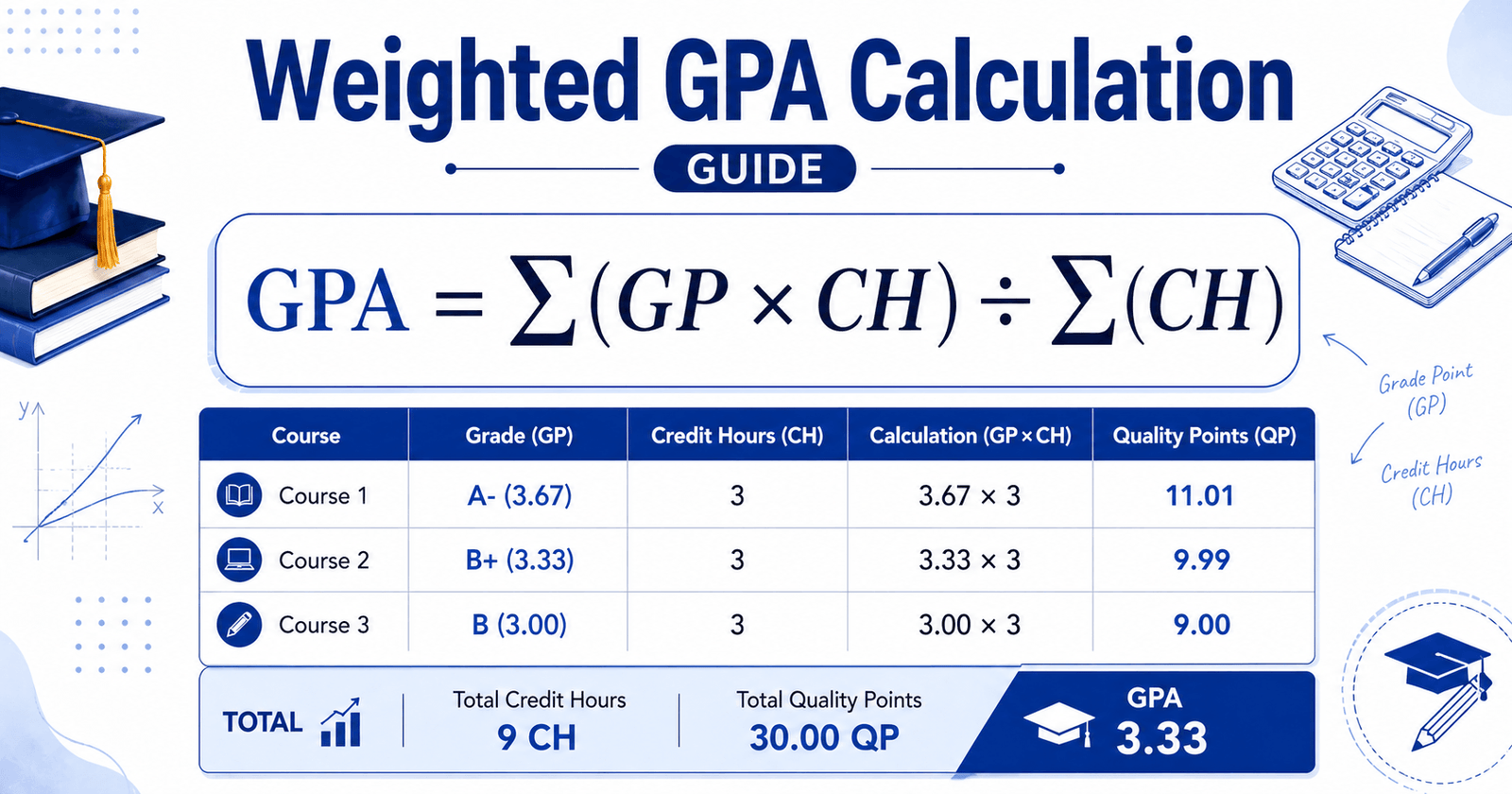
Every Pakistani university student has heard of CGPA, but far fewer understand what makes it a weighted average — and why this distinction matters enormously for academic strategy. A simple average treats every course equally. A weighted average treats higher-credit courses as more important. Understanding this weighting system is the foundation of intelligent CGPA planning at any Pakistani university.
Part 1: What "Weighted" Actually Means
In everyday language, "average" usually means adding numbers and dividing by how many there are. If you scored 80%, 70%, and 90% on three tests, your average is (80+70+90)÷3 = 80%.
A weighted average assigns different "weights" to different values based on their importance. In CGPA calculation, the weight of each course is its credit hour value. A 4-credit course has 4× the weight of a 1-credit course. This means:
- Your grade in Engineering Mathematics (4 CHs) affects your GPA 4× more than your grade in a 1-credit lab
- Your FYP grade (6 CHs) has 6× the GPA impact of a 1-credit course
- If you have two courses — one worth 4 CHs graded A (4.00 GP) and one worth 1 CH graded F (0.00 GP) — your GPA is NOT (4.00+0.00)/2 = 2.00. It is (4.00×4 + 0.00×1)/(4+1) = 16/5 = 3.20. The high-credit A grade massively outweighs the failed 1-credit course.
Part 2: The Weighted GPA Formula — Step by Step
Step 1: For each course, multiply grade points by credit hours → Quality Points
Step 2: Add all Quality Points together → Total Quality Points
Step 3: Add all credit hours together → Total Credit Hours
Step 4: Divide Total QP by Total CH → Weighted GPA
Part 3: Complete Worked Example With Different Credit Hours
| Course | Credit Hours | Grade | Grade Points | Quality Points (GP×CH) |
|---|---|---|---|---|
| Calculus III | 4 | A- | 3.67 | 14.68 |
| Data Structures | 3 | B+ | 3.33 | 9.99 |
| English Composition | 2 | A | 4.00 | 8.00 |
| Physics Lab | 1 | A+ | 4.00 | 4.00 |
| Pakistan Studies | 2 | B | 3.00 | 6.00 |
| Digital Logic | 3 | C+ | 2.33 | 6.99 |
| TOTAL | 15 | 49.66 |
Weighted GPA = 49.66 ÷ 15 = 3.31
Now watch what happens if we incorrectly calculate an unweighted average of grade points: (3.67 + 3.33 + 4.00 + 4.00 + 3.00 + 2.33) ÷ 6 = 20.33 ÷ 6 = 3.39
The simple average gives 3.39 but the correct weighted average is 3.31 — a 0.08 difference that could affect scholarship eligibility or Dean's List status. Why the difference? The 4-credit Calculus course (A-, 3.67) pulls the weighted average lower because it has more weight than the 1-credit lab (A+, 4.00) that inflates the simple average. Never use simple averaging for GPA calculation.
Part 4: How Weighting Affects CGPA Strategy
Understanding credit-hour weighting transforms how you think about study time allocation:
| Scenario | Credit Hours | GP Change | Extra Quality Points | GPA Impact (on 60 CH base) |
|---|---|---|---|---|
| Improve 1-CH lab: C→A | 1 | +2.00 | +2.00 | +0.033 |
| Improve 2-CH course: C→A | 2 | +2.00 | +4.00 | +0.067 |
| Improve 3-CH course: C→A | 3 | +2.00 | +6.00 | +0.100 |
| Improve 4-CH course: C→A | 4 | +2.00 | +8.00 | +0.133 |
| Improve 6-CH FYP: C→A | 6 | +2.00 | +12.00 | +0.200 |
The practical conclusion: allocate your study time proportional to credit hours. A 4-credit Engineering Mathematics course deserves 4× as much study time as a 1-credit lab, because improving your grade in the 4-credit course has 4× the CGPA impact. Your Final Year Project (FYP) deserves the most investment of all — its 6 credit hours give it the highest possible CGPA leverage of any single academic activity.
Part 5: The Cumulative Weighted GPA Across Semesters
Cumulative CGPA is calculated by combining ALL quality points and ALL credit hours from every semester — not by averaging semester GPAs:
| Semester | CHs | QPs Earned | Cumul. CHs | Cumul. QPs | Cumul. CGPA |
|---|---|---|---|---|---|
| Semester 1 | 15 | 45.00 | 15 | 45.00 | 3.00 |
| Semester 2 | 17 | 57.80 | 32 | 102.80 | 3.21 |
| Semester 3 | 17 | 49.66 | 49 | 152.46 | 3.11 |
| Semester 4 | 18 | 66.60 | 67 | 219.06 | 3.27 |
Notice Semester 3: even though the student earned 49.66 QPs on 17 CHs (GPA = 2.92), which is lower than their previous semesters, the cumulative CGPA only dropped from 3.21 to 3.11 — not to 2.92. The cumulative average dampens individual semester swings because it's weighted by all prior credit hours. This is both comforting (one bad semester doesn't destroy your CGPA) and frustrating (one great semester doesn't fix everything either).
Part 6: Why Simple Averaging of Semester GPAs Is Always Wrong
This mistake is remarkably common among Pakistani students. Here's a clear demonstration of why it fails:
Suppose two semesters:
- Semester A: GPA 2.50, 12 credit hours (light semester)
- Semester B: GPA 3.80, 21 credit hours (heavy semester)
Simple average (WRONG): (2.50 + 3.80) ÷ 2 = 3.15
Correct weighted average: (2.50×12 + 3.80×21) ÷ (12+21) = (30 + 79.80) ÷ 33 = 109.80 ÷ 33 = 3.33
The difference: 3.33 vs 3.15 — a full 0.18 CGPA points. In this case, Semester B (with the higher GPA) had more credit hours, so it deserves proportionally more influence on the cumulative average. The correct weighted calculation properly accounts for this.
Part 7: Course Repeat and the Weighted Average
When you retake a course under grade replacement policy, the new grade's quality points replace the original in the cumulative weighted calculation. The credit hours are counted only once (not twice). Here's how this works:
Original record: F (0.00 GP) in Engineering Mathematics (4 CHs) → 0.00 quality points
After retake: B+ (3.33 GP) in Engineering Mathematics (4 CHs) → 13.32 quality points
Net change to cumulative: +13.32 quality points (significant CGPA improvement)
On a cumulative record of 60 credit hours and 180 total quality points (CGPA = 3.00): adding 13.32 QPs from the retake → (180 + 13.32) ÷ (60 + 4) = 193.32 ÷ 64 = 3.02 CGPA — a modest but real improvement.
Part 8: University-Specific Weighted GPA Considerations
At NUST (7-Grade Scale)
NUST's grade boundaries jump by 0.50 GP each (A=4.00, B+=3.50, B=3.00, C+=2.50, C=2.00, D=1.00). Each boundary crossing adds 0.50 QP per credit hour. On NUST's common 4-credit Engineering Mathematics courses, crossing B to B+ adds 0.50 × 4 = 2.00 quality points per semester — substantial cumulative impact.
At COMSATS/FAST (HEC 12-Grade)
With smaller 0.33–0.34 GP increments between grade boundaries, weighted GPA improvement at COMSATS is more gradual. But the 12-grade system's granularity means improvement is achievable at many marks levels, not just at the wide boundaries of NUST's 7-grade or UET's 6-grade system.
At UET (6-Grade Scale)
UET's massive 1.00 GP jumps at each boundary (A=4.00, B=3.00, C=2.00, D=1.00) make weighted GPA extremely sensitive to grade boundaries. On a 4-credit course at UET, crossing from B to A at the 80% threshold adds 4.00 extra quality points — equivalent to an entire additional 3-credit course at A in terms of CGPA impact.
Part 9: Practical Tools for Weighted GPA Calculation
🧮 Use Our CGPA Calculator
Our free CGPA Calculator handles all weighted calculations automatically. Enter subject name, credit hours, and grade for each course — it computes quality points and weighted GPA instantly.
📊 University-Specific GPA
Our University GPA Calculator automatically applies the correct grade scale when you select your university (NUST, COMSATS, FAST, UET, UCP, IBA).
📈 Track Across Semesters
Our Multi-Semester Tracker lets you enter semester GPA and credit hours for each term and instantly see your weighted cumulative CGPA — no manual calculation needed.
🎯 Model Improvement Scenarios
Our CGPA Improvement Calculator uses the weighted formula to tell you exactly how many credit hours at a target GPA you need to reach your graduation CGPA goal.
Is CGPA always a weighted average in Pakistani universities?
Yes — all Pakistani universities that use a CGPA system calculate it as a weighted average where credit hours are the weights. No HEC-recognized university uses a simple (unweighted) average of grade points. The formula is always: Total Quality Points ÷ Total Credit Hours.
Do lab courses count in weighted GPA the same way lecture courses do?
Yes — lab courses contribute to weighted GPA based on their credit hour value (typically 1 CH). A lab graded A+ (4.00 GP) contributes 4.00 quality points. A lecture course graded A+ with 3 CHs contributes 12.00 quality points. They follow the same formula; only the credit hours differ.
Does a repeated course count twice in the weighted average?
No — under grade replacement policy at most Pakistani universities, the credit hours are counted only once in the denominator. The quality points from the repeat replace the original. Your total credit hours in the denominator reflect unique courses completed, not total course attempts.
Why do some online GPA calculators give different results than my official CGPA?
The most common cause is using the wrong grading scale. A calculator using COMSATS's HEC 12-grade scale will give different results for NUST students (who use a 7-grade scale). Always select your specific university in our University GPA Calculator to ensure the correct grade-to-point mapping is applied.