
About University of the Punjab — Pakistan's Oldest University
The University of the Punjab (PU), established in 1882 in Lahore, is Pakistan's oldest and one of its most venerable institutions of higher learning. With over a century of academic heritage, Punjab University has nurtured generations of Pakistan's scholars, politicians, scientists, writers, lawyers, and civil servants. Today PU operates through more than 50 academic departments, institutes, and constituent colleges, spanning disciplines from arts, humanities, and social sciences to pharmacy, management sciences, information technology, and engineering.
PU's academic landscape is more complex than most other Pakistani universities because of its sheer size and diversity. The university serves students on its iconic New Campus and Quaid-e-Azam Campus in Lahore, as well as through numerous affiliated colleges and sub-campuses across Punjab province. This diversity means that grading policies, academic requirements, and administrative procedures can vary meaningfully between departments, institutes, and programs.
Despite this complexity, all modern PU programs (particularly the BS 4-year Honors programs that are now the standard under HEC requirements) follow a broadly standardized CGPA system on a 4.0 scale. This guide focuses on the modern CGPA-based programs, while also explaining the older Division system that students in transitional programs may still encounter.
PU's Dual Grading System — Understanding Both
Punjab University currently operates two parallel systems depending on the program and year of admission:
System 1: Modern CGPA System (BS 4-Year Programs)
All students enrolled in BS (Hons) 4-year programs after HEC's mandate follow the modern CGPA system on a 4.0 scale. This applies to most undergraduate programs at PU's main campus departments and PUCIT (Punjab University College of Information Technology). The CGPA system is also used for all postgraduate programs (MS, MBA, PhD).
System 2: Traditional Division System (Older Programs & Affiliated Colleges)
Some older programs — particularly 2-year BA/BSc and certain affiliated college programs — may still use the traditional marks-based division system where final aggregate percentage determines a First, Second, or Third Division classification. If you are in an older program or affiliated college, always confirm with your department which system applies to your degree.
PU Modern CGPA Grading Scale (BS 4-Year Programs)
| Marks % | Letter Grade | Grade Points | Division | QP (3-CH) |
|---|---|---|---|---|
| 85 – 100 | A+ | 4.00 | First (Distinction) | 12.00 |
| 80 – 84 | A | 4.00 | First | 12.00 |
| 75 – 79 | B+ | 3.50 | First | 10.50 |
| 70 – 74 | B | 3.00 | First | 9.00 |
| 65 – 69 | C+ | 2.50 | Second | 7.50 |
| 60 – 64 | C | 2.00 | Second | 6.00 |
| 55 – 59 | D+ | 1.50 | Pass | 4.50 |
| 50 – 54 | D | 1.00 | Pass | 3.00 |
| Below 50 | F | 0.00 | Fail | 0.00 |
🔑 Key Difference from HEC Standard Scale
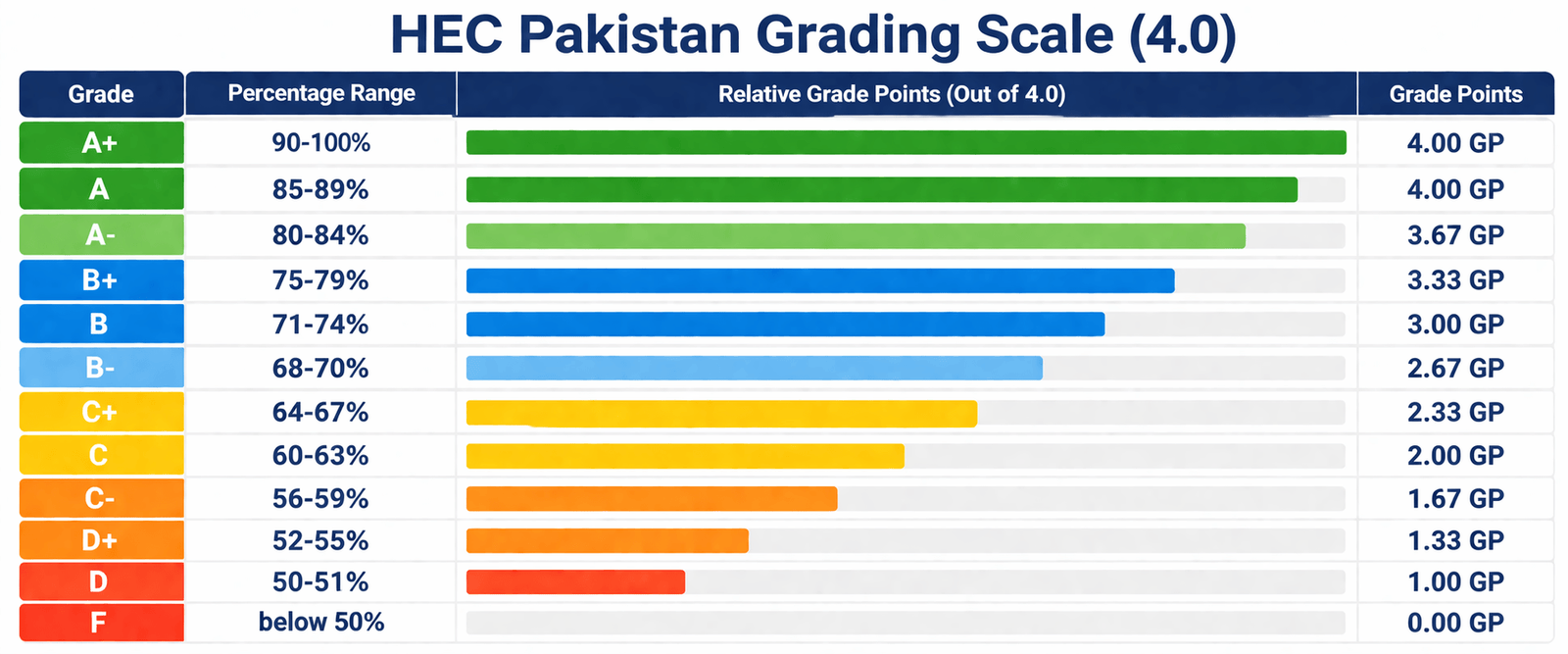
PU's scale differs from the HEC standard 12-grade scale in two important ways: (1) PU merges A+ and A (both earn 4.00 GP) with 85% as the combined threshold, while the HEC standard scale separates A+ (90%+) from A (85–89%); (2) PU uses B+ = 3.50 GP (same as NUST) versus HEC standard's B+ = 3.33 GP. This makes PU's scale slightly more generous at the B+ level than COMSATS or FAST, where B+ earns only 3.33 GP.
PU Division System — Traditional Classification
For programs still using the traditional division system, or as an overlay explanation of the CGPA thresholds:
| Classification | Marks % Equivalent | CGPA Equivalent | Significance |
|---|---|---|---|
| First Division with Distinction | 75% and above | 3.50+ | Highest academic recognition; Gold Medal territory |
| First Division | 60% – 74% | 3.00 – 3.49 | Strong academic performance; preferred by employers |
| Second Division | 45% – 59% | 2.00 – 2.99 | Adequate; meets minimum for most jobs and programs |
| Pass / Third Division | 33% – 44% | 1.00 – 1.99 | Minimum pass in older programs; modern programs require 50% |
| Fail | Below 33% | Below 1.00 | Fail; course retake required |
Note for modern program students: The minimum pass mark in modern BS 4-year programs at PU is 50%, aligning with HEC's standard. The old 33% pass threshold applies only to older programs that have not yet transitioned to the modern system.
PU GPA Calculation Example — BS English Literature (New Campus)
| Course | CH | Marks % | Grade | GP | QPs |
|---|---|---|---|---|---|
| Victorian Literature | 3 | 79 | B+ | 3.50 | 10.50 |
| Linguistics | 3 | 83 | A | 4.00 | 12.00 |
| Research Methods | 3 | 68 | C+ | 2.50 | 7.50 |
| Pakistan Studies | 2 | 87 | A+ | 4.00 | 8.00 |
| Translation Studies | 3 | 72 | B | 3.00 | 9.00 |
| TOTAL | 14 | — | — | — | 47.00 |
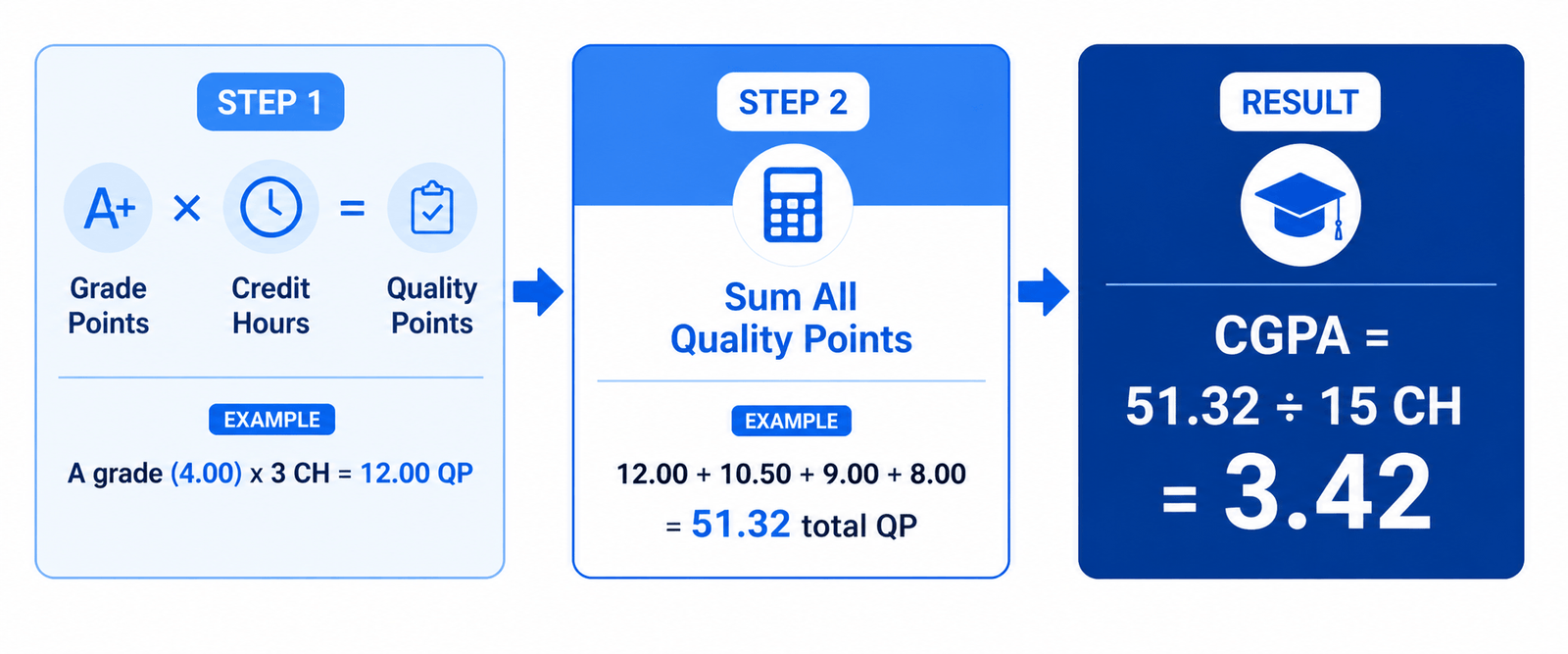
Semester GPA = 47.00 ÷ 14 = 3.36
This student is in First Division territory (3.00+) but below the First Division with Distinction threshold (3.50+). The Research Methods course (C+, 68%) is the primary drag. Improving it to B+ (75%+) would add 3.00 quality points and push the GPA to approximately 3.57 — qualifying for First Division with Distinction.
PU Gold Medal and Academic Honours
Punjab University's Gold Medal — awarded at the annual convocation by the Vice-Chancellor — is the university's highest academic honor. Gold Medals are awarded to the top student in each program based on overall cumulative CGPA. Key requirements include:
- Highest cumulative CGPA in the graduating batch for that program
- No failing grade (F) throughout the entire degree
- Completed the degree within the standard time frame (no extra years)
- No active disciplinary record throughout the degree
- Typically CGPA 3.75 or above, though the exact threshold depends on competition within the batch
| CGPA Range | Honor / Designation | Award |
|---|---|---|
| Highest in batch (≥3.75) | Gold Medal | Gold Medal from Vice-Chancellor |
| 3.75 – 4.00 | First Division with Distinction | Distinction noted on degree |
| 3.00 – 3.74 | First Division | First Division on degree/transcript |
| 2.00 – 2.99 | Second Division | Second Division on degree |
PU Academic Probation and Minimum Standards
Punjab University's modern BS programs require students to maintain a minimum cumulative CGPA of 2.00 for good academic standing. Students falling below this threshold face academic consequences:
- First Warning: CGPA below 2.00 — formal academic warning letter issued
- Probation: Continued failure to maintain 2.00 — placed on academic probation with restricted course load
- Academic Suspension: Failure to recover within probation period — possible exclusion from program
- Course Repeat: Most PU programs allow failed course retakes; grade improvement policy varies by department
PUCIT (Punjab University College of Information Technology)
Students at PUCIT — PU's dedicated IT college — should note that PUCIT typically follows a grading scale closer to the HEC standard 12-grade system rather than the general PU scale described above. If you are at PUCIT, your grading scale likely uses:
- A+ (90–100%): 4.00 GP
- A (85–89%): 4.00 GP
- A- (80–84%): 3.67 GP
- B+ (75–79%): 3.33 GP
- And so on following the standard HEC 12-grade structure
Always verify with PUCIT's academic office which exact scale applies to your program, as this affects your CGPA calculation directly.
PU CGPA to Percentage Conversion
Examples:
3.75 CGPA → 93.75% (First Division with Distinction)
3.50 CGPA → 87.5% (First Division with Merit)
3.00 CGPA → 75.0% (First Division)
2.50 CGPA → 62.5% (Second Division)
2.00 CGPA → 50.0% (Pass)
For official PU percentage certificates — needed for PPSC, government jobs, and graduate admissions — request the document from PU's Controller of Examinations office. The official certificate with PU's stamp and signature is the most credible format for formal submissions.
Department-Specific Grading at PU — What You Need to Know
Punjab University's decentralized departmental structure means grading culture and rigor differ meaningfully across the institution:
| Department/Institute | Typical Academic Intensity | Note |
|---|---|---|
| Institute of Administrative Sciences (IAS) | Moderate-High | Competitive for MBA/MPA programs |
| Dept. of Computer Science | High | Follows HEC-standard scale more closely |
| PUCIT | High | Often uses full HEC 12-grade scale |
| Dept. of Chemistry/Physics/Math | High | Rigorous science programs |
| Dept. of English/History/Philosophy | Moderate | Humanities grading typically more accessible |
| Institute of Education | Moderate | Education programs; assessment-based |
| Dept. of Pharmacy | Very High | Rigorous professional program |
| Affiliated Colleges | Variable | Policies vary; may use traditional division system |
CGPA Improvement Chart — Recovery Strategy
PU Career Outcomes and CGPA Relevance
For PU graduates, the practical importance of CGPA varies significantly by career path:
Government Sector (Most PU Graduates)
PU graduates disproportionately enter Pakistan's government sector — civil service (CSS/PMS), public sector education, government banks, and provincial departments. For these careers, academic marks (converted to percentage) contribute to merit calculations. A First Division degree (3.00+ CGPA or 60%+) is significantly advantageous over a Second Division, particularly for CSS and PPSC competitive exams where academic merit points can be decisive.
Private Sector
PU graduates entering the private sector — banking, media, corporate management, IT — will typically face CGPA screening. Most private employers require a minimum of 2.50 CGPA or 60% aggregate for consideration. For management trainee programs at large banks and corporations, 3.00+ CGPA from a recognized university like PU is preferred.
Graduate Studies
For MS/MPhil/MBA programs — whether at PU itself or elsewhere — a minimum 2.00 CGPA is required, with competitive programs preferring 2.50+ or 3.00+. For HEC scholarships and international programs, 3.00+ CGPA is the typical minimum.
6 Key Strategies for PU Students
📋 Know Your Department's Scale
Confirm which grading scale your specific PU department uses — the general PU scale, HEC 12-grade, or the old division system. This determines how your marks translate to grade points. Ask the departmental academic office directly.
🎯 Target the 75% Boundary
On the standard PU scale, crossing 75% earns B+ (3.50 GP) versus B (3.00 GP) below. The 75% threshold is a significant 0.50 GP jump per credit hour. Targeting 75%+ in every course as a floor target will keep your CGPA solidly in First Division territory.
💼 Aim for First Division
For government job merit calculations and CSS, a First Division degree (3.00+ CGPA) earns more merit points than Second Division. Even a fraction above 3.00 CGPA significantly improves your competitive standing for government positions.
📊 Calculate CGPA Accurately
Use our CGPA Calculator with the HEC standard scale (most similar to PU's main scale) to get accurate GPA estimates. Verify with your department's specific grade-to-point mapping if there are discrepancies.
🏆 Plan for Gold Medal Early
If you're aiming for a Gold Medal, start tracking class-level performance from Semester 1. The Gold Medal goes to the highest CGPA in your graduating batch — knowing where you stand relative to top peers helps motivate consistently high performance.
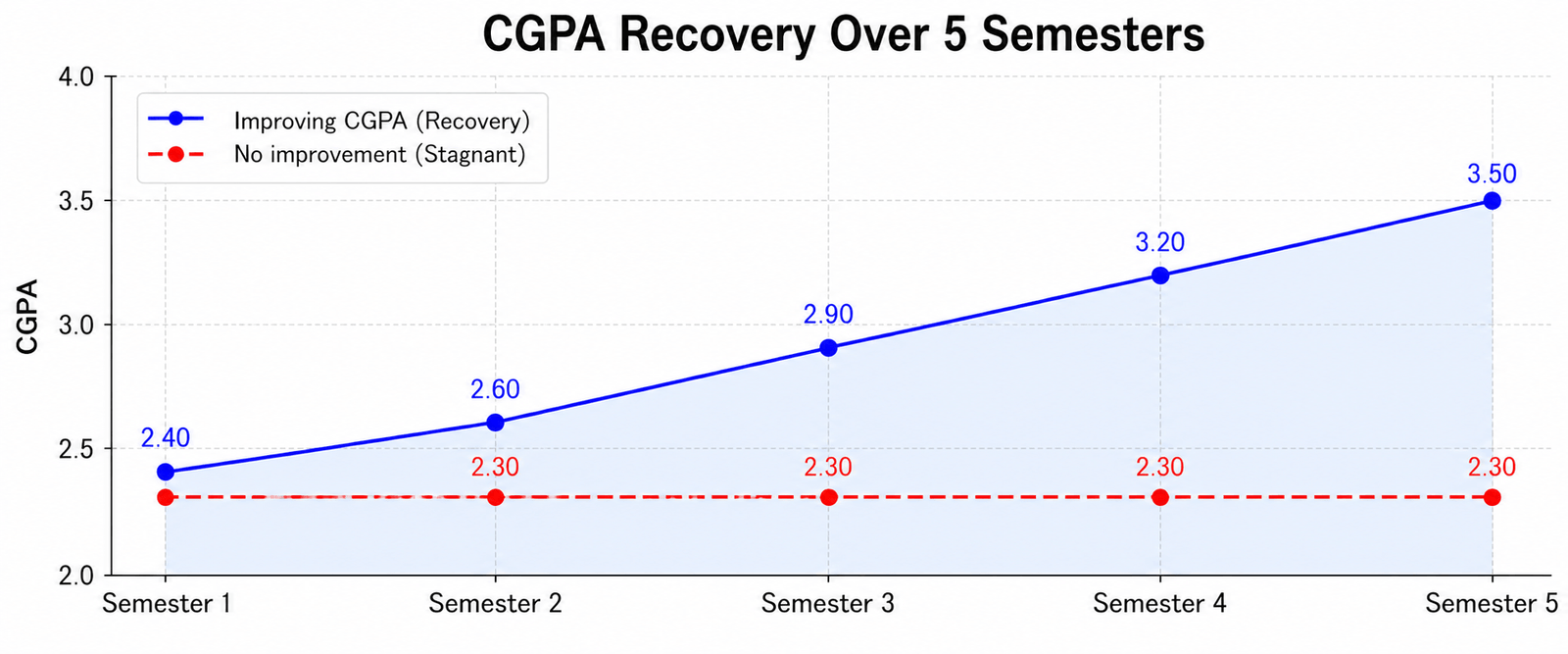
📈 CGPA Improvement Planning
Use our CGPA Improvement Calculator to model how many more semesters at a target GPA will move you from Second Division to First Division, or from First Division to Distinction level.
PU CGPA Requirements — Complete Reference
| Purpose | Minimum CGPA | Notes |
|---|---|---|
| Graduation (modern BS programs) | 2.00 | Standard HEC requirement |
| MS/MPhil Admission (PU) | 2.00 | Competitive: 2.50+ |
| First Division | 3.00 | 60%+ equivalent |
| First Division with Distinction | 3.75 | 75%+ equivalent |
| Gold Medal | Highest in batch (≥3.75) | Per program |
| Academic Probation | Below 2.00 | Warning then probation |
| Government Job Merit (2nd Div) | 2.00 (50%) | Minimum for most posts |
| Government Job Merit (1st Div) | 3.00 (60%) | Higher merit points |
Does a PU degree from an affiliated college have the same recognition as a main campus degree?
Yes — degrees from HEC-recognized PU affiliated colleges carry the same official recognition as main campus degrees. The degree is issued in the name of University of the Punjab regardless of the college. However, some employers and graduate programs may informally prefer main campus graduates, particularly for competitive positions.
How does PPSC treat PU CGPA for civil service merit?
PPSC (Punjab Public Service Commission) uses your degree classification (First Division, Second Division) to assign academic merit points. A First Division degree earns more points than Second Division. Convert your CGPA to percentage using the ×25 formula and identify which division you fall in for your PPSC application.
Can PU students transfer credit hours from affiliated colleges to the main campus?
Credit transfer policies between PU affiliated colleges and the main campus vary. PU's Registrar Office handles transfer credit applications on a case-by-case basis. Not all credits from affiliated colleges are automatically accepted at main campus programs.