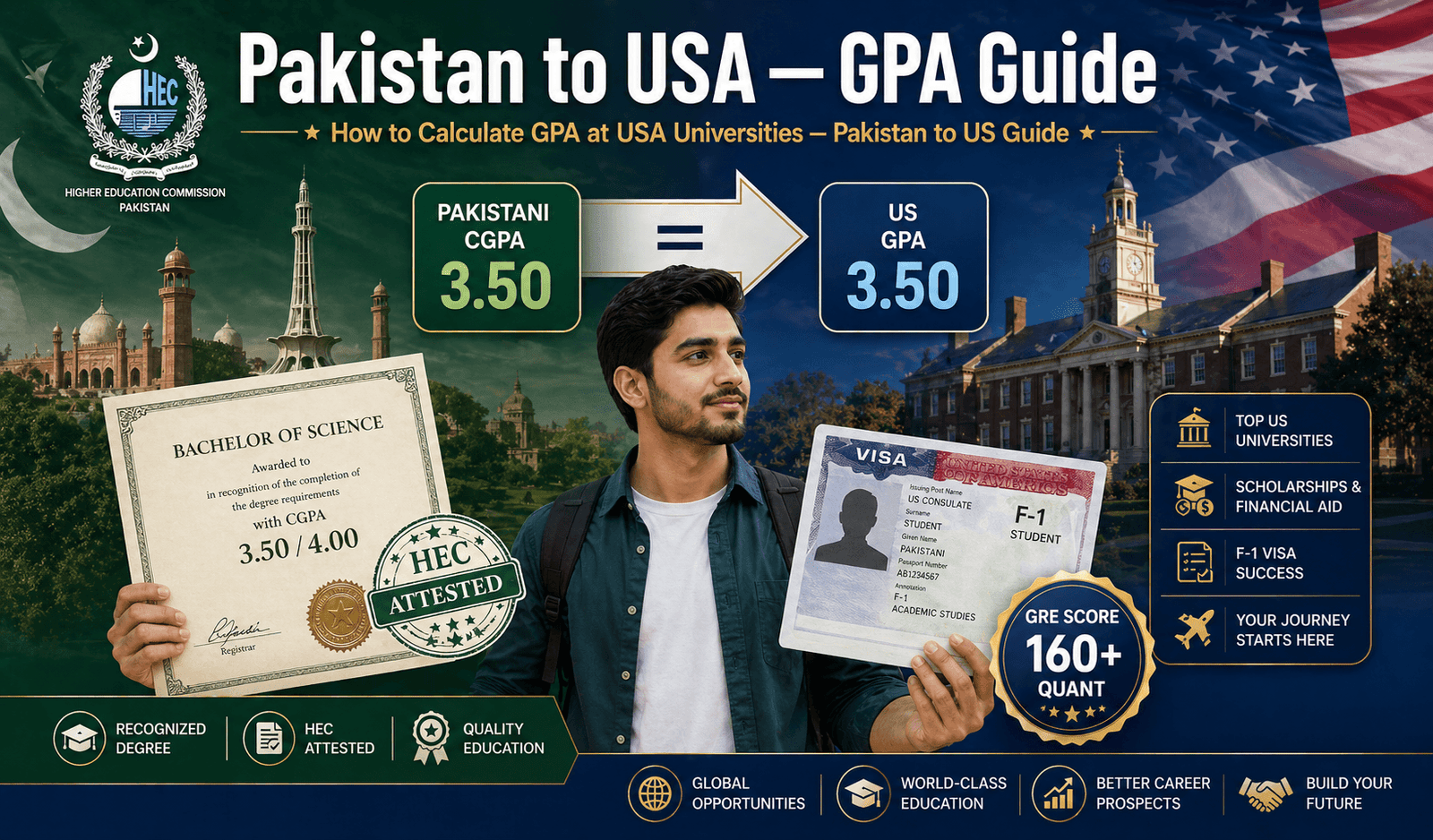
Thousands of Pakistani students apply to US universities every year for MS and PhD programs. Whether you're applying fresh from your BS degree or after several years of work experience, understanding how the American GPA system works — and how your Pakistani CGPA translates into it — is essential for crafting a competitive application.
This comprehensive guide explains the US GPA system, how Pakistani CGPA maps to American grade scales, which US universities are most accessible to Pakistani applicants at different CGPA levels, the complete GRE and TOEFL requirements, the F-1 visa process, and funding strategies for Pakistani students in the US.
Part 1: The US GPA System — How It Works
American universities use a 4.0 GPA scale similar in structure to Pakistan's HEC standard scale, but with important differences in letter grade assignment and cultural interpretation:
| US Grade | Grade Points | Percentage Equivalent | What It Means in US Context |
|---|---|---|---|
| A+ | 4.00 (or 4.33 at some schools) | 97–100% | Rare; exceptional performance |
| A | 4.00 | 93–96% | Excellent — expected of top performers |
| A- | 3.67 | 90–92% | Very good — above average performance |
| B+ | 3.33 | 87–89% | Good — solid student performance |
| B | 3.00 | 83–86% | Average — meets expectations |
| B- | 2.67 | 80–82% | Below average by US graduate standards |
| C+ | 2.33 | 77–79% | Poor by graduate standards |
| C | 2.00 | 73–76% | Minimum passing at most US schools |
| F | 0.00 | Below 60% | Fail |
Part 2: How Pakistani CGPA Maps to US Graduate School Expectations
Pakistani CGPA on the 4.0 HEC scale is directly comparable to the US 4.0 GPA scale in numerical terms. A Pakistani CGPA of 3.5 = US GPA of 3.5, and US graduate admissions committees use this equivalence when evaluating Pakistani applications. The key mapping:
| Pakistani CGPA (HEC 4.0) | US GPA Equivalent | US Graduate School Standing | Typical US Target Schools |
|---|---|---|---|
| 3.70–4.00 | 3.70–4.00 | Outstanding — top applicant | MIT, Stanford, Carnegie Mellon, UC Berkeley, Georgia Tech |
| 3.50–3.69 | 3.50–3.69 | Excellent — strong applicant | UCSD, Michigan, Purdue, UT Austin, UIUC, UCLA |
| 3.30–3.49 | 3.30–3.49 | Good — competitive applicant | ASU, NCSU, Rutgers, UMass Amherst, Ohio State |
| 3.00–3.29 | 3.00–3.29 | Average — apply strategically | Syracuse, Binghamton, Florida Atlantic, UMass Lowell |
| 2.70–2.99 | 2.70–2.99 | Below average — very selective programs | Some state universities; consider conditional admission |
Part 3: WES Credential Evaluation for Pakistani Degrees
Most US universities and immigration authorities require evaluation of foreign educational credentials by a recognized credential evaluation agency. For Pakistani degrees, the most commonly required agencies are:
WES (World Education Services)
WES is the most widely recognized credential evaluator in North America. For Pakistani BS degrees, WES evaluates:
- Degree equivalency (does the Pakistani BS equivalent to a US Bachelor's?)
- GPA conversion (converts your 4-year BS CGPA to a US GPA equivalent)
- Institution recognition (is the Pakistani university HEC-recognized?)
WES evaluation process for Pakistani students:
- Create account at wes.org
- Select evaluation type (Document-by-Document or Course-by-Course)
- Request official transcripts from your Pakistani university sent directly to WES
- Submit HEC-attested degree for WES verification
- WES issues evaluation report (4–7 weeks processing)
- Share WES report with US universities alongside official application
ECE (Educational Credential Evaluators)
ECE is another recognized evaluator, accepted by many US universities and states. Slightly lower cost than WES. Check each program's accepted evaluators before choosing.
Part 4: GRE Requirements for Pakistani Applicants
The GRE (Graduate Record Examination) is required or recommended by most US graduate programs. The GRE has three sections:
| Section | Score Range | Target for STEM | Target for Business/Social Sci |
|---|---|---|---|
| Quantitative Reasoning | 130–170 | 162+ (87th percentile) | 155+ (69th percentile) |
| Verbal Reasoning | 130–170 | 150+ (47th percentile) | 158+ (79th percentile) |
| Analytical Writing | 0–6 | 3.5+ (adequate) | 4.0+ (good) |
Pakistani applicants from engineering and CS backgrounds typically score very well on GRE Quantitative (often 160+) but may need more preparation for Verbal Reasoning. Budget 3–4 months of preparation:
- Quantitative: ETS Official GRE Guide + Manhattan Prep Quant strategies
- Verbal: Vocabulary building (Magoosh GRE Vocabulary), Reading Comprehension practice
- Analytical Writing: ETS scoring guides + 10 timed essay practices
- Practice tests: Take at least 4 full-length official GRE practice tests under timed conditions
GRE-Optional Trend: Many top US CS programs (MIT, Stanford, CMU, UC Berkeley) have permanently dropped the GRE requirement post-COVID. Check each program's current requirements — submitting a strong GRE score when optional can strengthen an application, but a weak score when optional should not be submitted.
Part 5: TOEFL and IELTS Requirements
English proficiency tests are required for all international students from non-English-primary educational systems. Pakistani students must submit either TOEFL or IELTS scores:
| Test | Min for Most Programs | Competitive Score | Top-School Score |
|---|---|---|---|
| TOEFL iBT | 79–80 overall | 90–100 | 100+ (top schools) |
| IELTS Academic | 6.0–6.5 overall | 7.0 | 7.5+ (top schools) |
| Duolingo English Test | 100–105 | 115+ | 120+ (where accepted) |
TOEFL is more widely accepted at US universities than IELTS. Most Pakistani students preparing for US graduate applications should take TOEFL iBT. Register at ets.org. Preparation resources: ETS Official TOEFL Guide, Magoosh TOEFL, Kaplan TOEFL.
Part 6: F-1 Student Visa Process for Pakistani Students
After receiving a US university acceptance and your I-20 (Certificate of Eligibility for Nonimmigrant Student Status), you apply for the F-1 Student Visa at the US Embassy Islamabad or US Consulate Lahore/Karachi:
- Pay SEVIS fee (I-901): Pay online at fmjfee.com — currently $350 for F-1 visa
- Complete DS-160: Fill out the online nonimmigrant visa application at ceac.state.gov
- Schedule interview: Book a visa interview appointment at the US Embassy Islamabad or Consulate (Lahore or Karachi) through ustraveldocs.com/pk
- Prepare documents: Passport, I-20, DS-160 confirmation, SEVIS receipt, admission letter, financial documentation (bank statements showing sufficient funds), academic transcripts and degree, IELTS/TOEFL score
- Attend interview: The consular officer will ask about your study plans, financial support, ties to Pakistan, and plans to return after studies
- Receive visa: Most Pakistani student visa applications for accredited US universities are approved if documentation is complete and compelling
Key Interview Tips for Pakistani F-1 Visa Applicants
- Demonstrate strong ties to Pakistan: family, property, employment prospects, career plans that require return
- Be specific about your program, institution, and career goals — vague answers raise doubts about genuine academic intent
- Show adequate funding: US graduate school costs $25,000–$60,000 per year including living expenses; funded students (TA/RA) should bring award letters
- Speak confidently about your field of study — consular officers test whether you genuinely understand what you're going to study
Part 7: Funding for Pakistani Students at US Universities
The cost of US graduate education can be prohibitive without funding. Pakistani students have several funding pathways:
Teaching Assistantship (TA)
PhD programs and many MS programs at research universities offer Teaching Assistantships that cover full tuition waiver plus a monthly stipend (typically $1,500–$2,500 per month depending on university and location). TA offers are the most common funding mechanism for Pakistani PhD students. Requirements: strong academic record (CGPA 3.3+), good English communication, relevant background to assist undergraduate courses.
Research Assistantship (RA)
Research Assistantships are funded through faculty research grants. Getting an RA offer requires connecting directly with a professor whose research aligns with your interests. The most effective strategy: email target professors 6–12 months before application deadline with a specific, personalized message about their research and your relevant background. Include your CV and any research work.
Fulbright Pakistan
Covers full tuition, monthly stipend ($1,800–$2,200), health insurance, and round-trip travel. Pakistan receives approximately 25–40 Fulbright awards per year. Minimum 3.0 CGPA; competitive 3.5+. Work experience required. Opens January annually.
University Merit Scholarships
Some US universities offer merit-based scholarships specifically for international students. These vary widely — from partial tuition waivers to full fellowships. Check each university's international student scholarship page during the application process.
Part 8: Top US Universities for Pakistani Engineering/CS Students
| University | Program Strength | Min CGPA (approx) | Pakistani Student Community |
|---|---|---|---|
| Carnegie Mellon University | CS, AI, ML, Robotics | 3.5+ | Active Pakistani student association |
| Georgia Institute of Technology | EE, CS, Mechanical | 3.3+ | Large Pakistani cohort annually |
| University of Illinois Urbana-Champaign | CS, EE, Materials | 3.3+ | Strong Pakistani alumni network |
| Purdue University | Engineering (all), CS | 3.0+ | Large Pakistani student community |
| Arizona State University | CS, EE, Sustainability | 2.8+ | Growing Pakistani community; accessible |
| University of Texas at Dallas | CS, EE, Business | 2.8+ | Very large Pakistani population in Dallas |
| SUNY Binghamton | CS, EE, ME | 2.7+ | Affordable; accessible for Pakistani applicants |
🎯 Apply Broadly
Apply to 8–12 US programs across competitive tiers: 2–3 reach schools (top 20), 4–5 match schools (top 50–100), 2–3 safety schools. Single-school US applications are extremely high-risk strategies.
📧 Email Professors Early
For research programs, email potential PhD supervisors 6–12 months before deadline. A specific, research-focused email showing genuine knowledge of their work gets responses; generic "I would like to join your lab" emails do not.
💰 Focus on Funded Programs
Prioritize programs that offer TA/RA funding. Self-funded US graduate education is financially risky. Accepted PhD programs almost always include full funding; MS programs vary — research each program's funding rates before applying.
📊 Use Our Scale Converter
Use our GPA Scale Converter to understand how your Pakistani CGPA maps on the US 4.0 scale for application purposes and WES credential evaluation.
Do US universities accept Pakistani degrees without WES evaluation?
Some do — particularly for PhD applications where the department evaluates credentials directly. However, many require WES or equivalent evaluation, especially for visa purposes. Check each program's specific requirements. For HEC Overseas scholarship applications, official transcripts and HEC attestation are typically sufficient without WES.
Is a NUST CGPA of 3.0 equivalent to a US GPA of 3.0?
In numerical terms, yes — both are on 4.0 scales. US admissions committees familiar with NUST treat 3.0 as equivalent. However, NUST's academic rigor means a 3.0 from NUST may represent stronger underlying ability than 3.0 from a less demanding institution. Reputation of your Pakistani university matters in context.
How long does it take to get an F-1 visa from Pakistan?
After scheduling your visa interview (1–4 weeks wait for appointment in 2025), the interview itself takes 10–30 minutes. Visa processing after interview: 3–7 business days in most cases. Total timeline from acceptance to having visa in hand: 4–8 weeks. Apply for your visa as soon as you receive your I-20 and have your SEVIS fee paid.