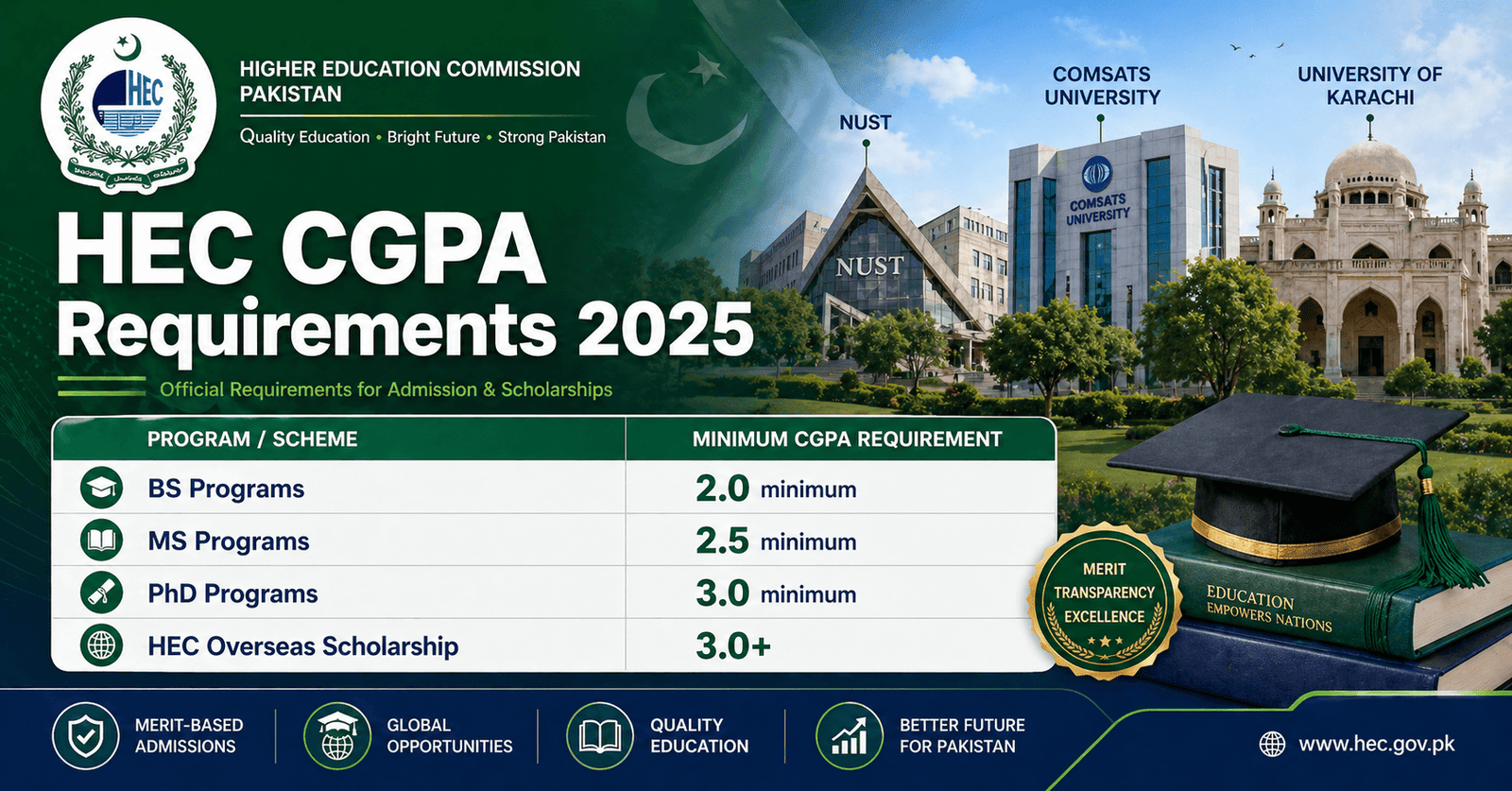
The Higher Education Commission of Pakistan (HEC) is the regulatory body that sets minimum standards for degree programs across all Pakistani universities. Understanding HEC's role — and what CGPA requirements it mandates versus recommends — is essential for every Pakistani student making decisions about program enrollment, academic performance targets, and graduate study plans.
This comprehensive guide explains HEC's grading framework, minimum CGPA requirements for graduation and scholarships, HEC's degree verification system, how HEC recognizes universities, and what you need to know about navigating HEC's rules as a student in 2025.
Part 1: HEC's Role in Pakistani Higher Education
HEC was established in 2002 to replace the University Grants Commission (UGC) with a mandate to improve quality, expand access, and align Pakistani universities with international standards. HEC's core functions include:
- Recognition of Universities: HEC maintains the official list of degree-awarding institutions whose degrees are valid for government employment, graduate admission, and international use
- Degree Attestation: HEC attests (verifies) educational documents for international use — employers, embassies, and foreign universities require HEC-attested documents
- Scholarship Programs: HEC manages major scholarship programs including Indigenous PhD Fellowship, Overseas Scholarship (MS/PhD), Need-Based Scholarship, and others
- Quality Assurance: Through the Quality Assurance Agency (QAA), HEC conducts institutional reviews and program evaluations
- Curriculum Standards: HEC issues model curricula for major disciplines that universities are expected to follow with appropriate local adaptation
- Grading Framework: HEC recommends the 4.0 GPA scale and 12-grade system (though universities retain autonomy to adapt within this framework)
Part 2: HEC Minimum CGPA Requirements — Official Standards
For Graduation (Bachelor's Programs)
HEC mandates that all BS (4-year) programs require a minimum cumulative CGPA of 2.00 out of 4.00 for graduation. Students who complete all required credit hours but have cumulative CGPA below 2.00 cannot be awarded their degree. They must take additional courses or repeat low-graded courses to raise their CGPA above 2.00.
For MS/MPhil Programs
HEC's minimum requirement for MS/MPhil graduation is also 2.00 cumulative CGPA. Additionally, thesis-based MS programs require satisfactory completion and defense of the thesis, while coursework-only MS programs require completion of the designated credit hours with adequate GPA.
For PhD Programs
PhD program completion at HEC-recognized universities requires minimum CGPA of 3.00 in the coursework component (typically 18 credit hours of courses before thesis) and successful completion, submission, and defense of the PhD dissertation. HEC's doctoral standards also require PhD students to publish at least one paper in an HEC-recognized journal before degree award — a requirement that has been controversial but remains policy.
Part 3: HEC's Recommended Grading Scale
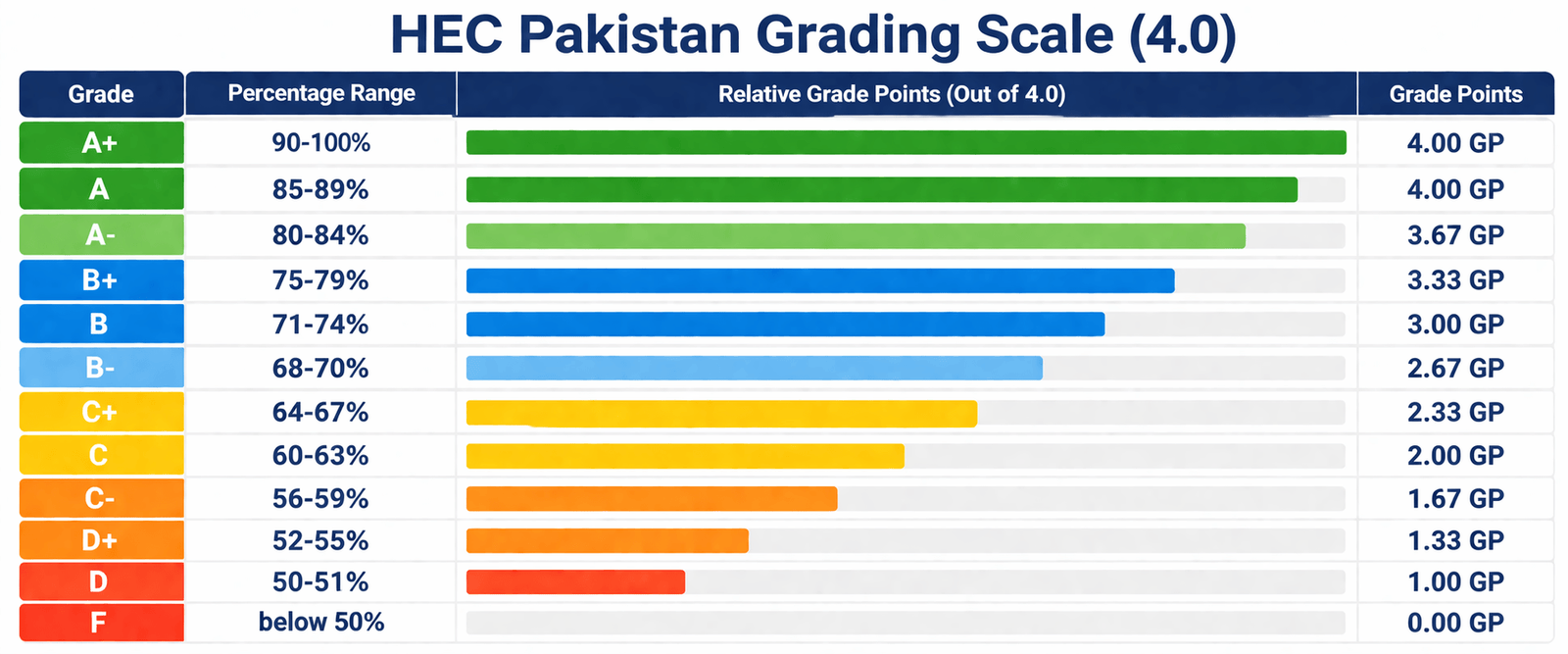
HEC recommends the following 12-grade system for all Pakistani universities. While universities retain autonomy to adapt this framework, most follow it closely:
| Marks % | Grade | Grade Points | Classification |
|---|---|---|---|
| 90–100 | A+ | 4.00 | Outstanding |
| 85–89 | A | 4.00 | Excellent |
| 80–84 | A- | 3.67 | Very Good |
| 75–79 | B+ | 3.33 | Good |
| 71–74 | B | 3.00 | Above Average |
| 68–70 | B- | 2.67 | Average |
| 64–67 | C+ | 2.33 | Below Average |
| 60–63 | C | 2.00 | Satisfactory |
| 56–59 | C- | 1.67 | Low Pass |
| 52–55 | D+ | 1.33 | Very Low Pass |
| 50–51 | D | 1.00 | Minimum Pass |
| Below 50 | F | 0.00 | Fail |
Part 4: HEC Scholarship Programs — CGPA Requirements
HEC Need-Based Scholarship
The HEC Need-Based Scholarship provides financial support to academically eligible students from low-income families. Key eligibility criteria:
- Enrolled in a BS program at an HEC-recognized university
- Minimum academic requirement: Satisfactory academic progress (2.00+ CGPA and no active academic probation)
- Family income criterion: Monthly family income below HEC's annually-set threshold (typically Rs. 45,000)
- Income must be verified through official government-issued income certificate
- Applications typically open twice annually (fall and spring semester beginning)
- Continuation: Must maintain satisfactory academic progress each semester
HEC Indigenous PhD Fellowship
For Pakistani scholars pursuing PhD at Pakistani universities in HEC's priority fields:
- Minimum BS CGPA: 3.00 (from 4-year BS/BE program)
- Competitive CGPA: 3.50+ significantly improves selection prospects
- Applicants with MS/MPhil must have minimum 3.00 CGPA in their postgraduate degree
- GAT Subject score: 60+ recommended
- Research publications: Conference or journal papers strengthen application considerably
- Must be enrolled at or admitted to HEC-recognized Pakistani university for PhD
- Priority fields change annually — check HEC website for current priority discipline list
HEC Overseas Scholarship (MS/PhD Abroad)
For Pakistani scholars pursuing MS leading to PhD at top-ranked international universities:
- Minimum BS CGPA: 3.00 from 4-year program at HEC-recognized university
- Competitive CGPA for selection: 3.50+
- GAT General: Minimum 60 (higher standard than university admission minimum of 50)
- IELTS: Minimum 6.5 overall, no individual band below 6.0
- University acceptance: Must have offer of admission from a university ranked in QS Top 500
- Field of study: Must be in HEC's declared priority fields (STEM, emerging technologies)
- Service bond: Must return to Pakistan and serve in academic/research sector for double the scholarship duration after completion
Part 5: HEC Recognized vs HEC Affiliated — Critical Distinction
There are three categories of educational institutions in Pakistan:
- HEC-Recognized Degree-Awarding Institutions (DAIs): Universities with independent degree-awarding powers. Degrees carry full HEC recognition. This includes public universities (NUST, UET, Punjab University, Peshawar University) and private universities (COMSATS, FAST, LUMS, IBA, Lahore School of Economics, etc.)
- HEC-Affiliated Colleges: Colleges affiliated with HEC-recognized universities. They offer programs leading to that university's degree — not an independent degree. The degree certificate is issued by the university, not the college. Carries full HEC recognition through the parent university.
- Non-HEC Institutions: Coaching academies, non-accredited private institutes, and some foreign university campuses operating without proper authorization. Degrees from these institutions have no HEC recognition and are essentially worthless for formal employment or further study purposes.
How to Verify HEC Recognition
Before enrolling in any program, verify recognition at hec.gov.pk → Universities → Recognized Universities. Check for:
- The institution appears in HEC's recognized DAI list
- Recognition status shows "Valid" (not "Expired" or "W-Category")
- W-Category means the institution is under warning — admissions may be frozen
- The specific program you intend to enroll in is listed under that institution's recognized programs
Part 6: HEC Degree Attestation — How It Works
HEC attestation is required for:
- International study applications (foreign universities require attested Pakistani degrees)
- Employment abroad
- Immigration and visa applications requiring educational credential verification
- Some government job applications that explicitly require HEC attestation
The Attestation Process (Step by Step)
- University Attestation: Take your original degree and transcript to your university's Controller of Examinations. They stamp and sign confirming authenticity. (1–2 weeks)
- HEC Attestation: Submit university-attested documents to HEC's regional office or main HEC office in Islamabad. HEC verifies the documents against their records and applies their attestation stamp. (1–3 weeks)
- Ministry of Foreign Affairs (MOFA) Attestation: For international use, MOFA attestation is also required. Submit HEC-attested documents to MOFA. (1–2 weeks)
- Embassy Attestation (if required): Some countries require additional attestation from the relevant country's embassy in Pakistan. (Varies by country)
Total attestation timeline: Allow 4–8 weeks. Start this process early — ideally 3 months before you need the documents for any international application deadline.
Part 7: HEC's CGPA Percentage Conversion Policy
HEC has its own recommended CGPA-to-percentage conversion methodology, which may differ slightly from the simple ×25 formula used at most universities. HEC's formula considers factors beyond the raw CGPA number. For official HEC applications (scholarships, attestation, international submissions), always request the official percentage equivalence certificate from your university's Registrar — not just a self-calculated conversion.
For formal HEC submissions, request official certificate from university Registrar.
Part 8: HEC's W-Category Universities — What It Means
HEC periodically places universities on the W-Category (Warning Category) when they fail to meet minimum quality standards. W-Category designation can mean:
- Admissions may be frozen (no new students can enroll)
- Current students may continue their programs but face uncertainty about degree recognition upon graduation
- Degree attestation may be complicated or delayed
- Employers and graduate programs may question the validity of degrees from W-Category institutions
Always check current W-Category status at hec.gov.pk before applying to any institution, particularly smaller private universities.
Does HEC set the CGPA scale or do universities decide?
HEC recommends the 12-grade 4.0 scale, but universities retain autonomy to adapt within this framework. This is why NUST uses a 7-grade system and UET uses a 6-grade system — both are HEC-recognized despite deviating from the recommended standard. HEC's minimum standards (2.00 for graduation, specific scholarship thresholds) are mandatory; the specific grade categories are recommended.
Can I get HEC attestation if my university is on W-Category?
HEC attestation for degrees already awarded before W-Category designation is generally possible, though may require additional verification steps. Degrees awarded during or after W-Category designation are more complicated. Contact HEC's attestation division directly for guidance specific to your situation.
How long does HEC need-based scholarship last?
The HEC Need-Based Scholarship typically covers the duration of your degree program (4 years for BS), provided you maintain satisfactory academic progress (2.00+ CGPA) each semester. It is reassessed at the start of each academic year based on continued eligibility.
What is the HEC recognized journal list for PhD publication requirements?
HEC maintains the Pakistan Journal of Quality Index (PJQI) and also recognizes publications in journals indexed by recognized international databases (Scopus, Web of Science, SCI, ESCI). Check HEC's website for the current approved journal list for your discipline, as it is updated periodically.